Repeat Signs - Music Theory
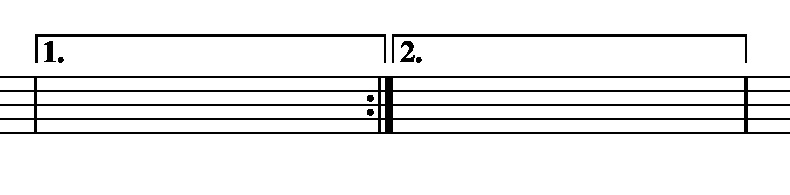
There are many different markings that tell the singer or performer that certain parts of a musical piece should be played again, sparing the composer from having to write out that passage more than once.
Depending on the length of the excerpt that needs to be repeated, there are different symbols you can use. To find out what they are, be sure to read this new article.
Repeat Bar
To write it, you place a double barline with two stacked dots in the center at the measures that should be repeated. These sections can also be broken up with brackets above the staff, and it's very common to see two brackets (known as voltas, or first and second endings) within a repeated section. When you read a piece and reach the first ending, you play it the first time through; on the repeat, you skip straight to the second ending and then continue with the rest of the music.

Measure Repeat Sign

It consists of a diagonal slash with a dot on either side, and it indicates that the previous measure should be played again.
Da Capo

These Italian words mean "from the beginning" and are written to let the performer know that the piece should be repeated from the top in its entirety.
Fine

This word is written to mark the end of the piece. Often you repeat just a few measures from the beginning and then jump to the Fine; this instruction is called "Da Capo al Fine."
Coda and the Segno
Either of these two symbols can be placed at a section of the score that you want to repeat. They are easy to recognize: the Coda is an oval crossed by a cross, while the Segno is a kind of stylized S crossed by a diagonal line with a dot on either side.
To know exactly how the passages should be repeated, there has to be a prior instruction such as D.S. al Coda, which means "from the Segno to the Coda," and so on.
Now that we know the repeat signs, it's important to always observe them whenever they appear in the score, so that the music you perform makes proper sense.
Other Basic Concepts in Learning Music
Studying music requires learning certain techniques and concepts that you'll need to master throughout this wonderful profession. If you want to know what some of those other basic concepts are, keep reading:
Anacrusis (Pickup)
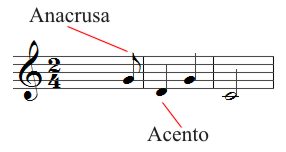
It's one of the most important devices for beginning a musical work. It's a note that falls on a weak beat of a measure. This device is used to create a sense of forward momentum, or urgency, within the piece.
Offbeat

We have an offbeat when a note is played or sung on the weak beat or weak part of the beat, while there are rests on the strong beat or strong part of the measure. It's often a key element within accompaniments.
Double Barline
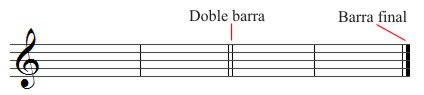
It's the symbol placed at the end of a complete piece or of one of its movements.
Syncopation

It's defined as a sound articulated on a weak beat or weak part of the beat that is sustained through to a strong beat or strong part of the beat.
Each of these basic concepts is highly important in the study of music. Make a point of practicing them so that, little by little, you become a top-level musician.