The Basics of Music Theory (Part 2)
In this second part of The Basics of Music Theory, you'll learn more fundamental concepts for understanding music, including rests, scales, and accidentals. If you're looking to deepen your knowledge, keep reading this new article.
Silence is music too!
If you've spent years dedicated to this noble craft, you've probably heard this saying before. And if not, you've come to the right place to learn it. In music, there isn't sound all the time; there also has to be silence to create a balance between the various melodies being played.
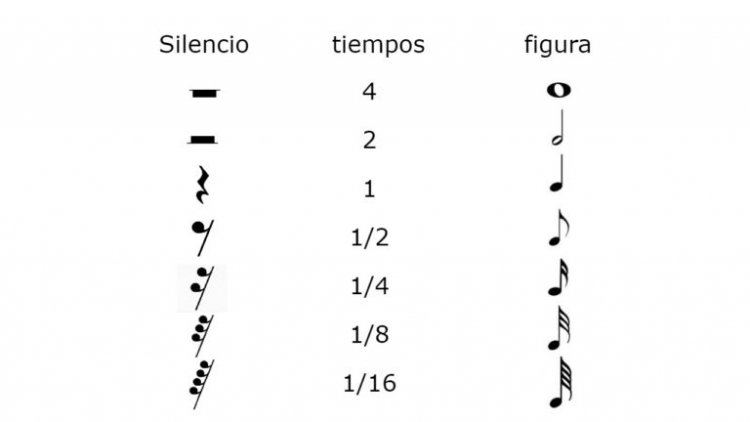
Technically, rests are defined as symbols that indicate the momentary absence of a particular sound. They are written on the staff, and just as there are note values, there are also rest values, each of which has the same duration as its corresponding note.
- Whole rest: this is the longest, since it lasts four beats. It's the only one that must be written hanging below the fourth line of the staff.
- Half rest: lasts two beats.
- Quarter rest: just like the note, it lasts one beat.
- Eighth rest: lasts half a beat.
- Sixteenth rest: its duration is a quarter of a beat.
- Thirty-second rest: lasts 1/8 of a beat.
- Sixty-fourth rest: worth 1/16 of a beat.
The remaining rests, on the other hand, can be written anywhere on the staff.
What is a scale?
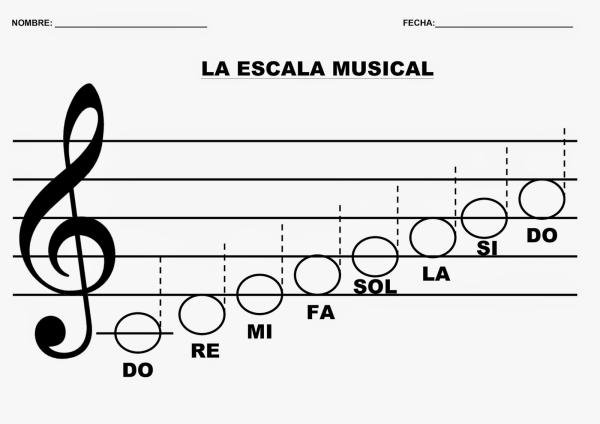
A scale is a series of eight sounds played in sequence. Its defining feature is that it must begin and end on the same note. When it's a major scale, it's made up of five whole tones and two diatonic semitones. But what does that mean? Don't worry, I'll explain it in the lines below:
The C scale is made up of the seven notes mentioned earlier: C, D, E, F, G, A, B. To complete this scale, you repeat C once more; this gives you the eight sounds described in the definition.
Now then, this scale is built from whole tones and semitones, two concepts that are very easy to memorize and apply:
- A whole tone: the larger distance between two notes.
- A semitone: the smaller distance between two notes.
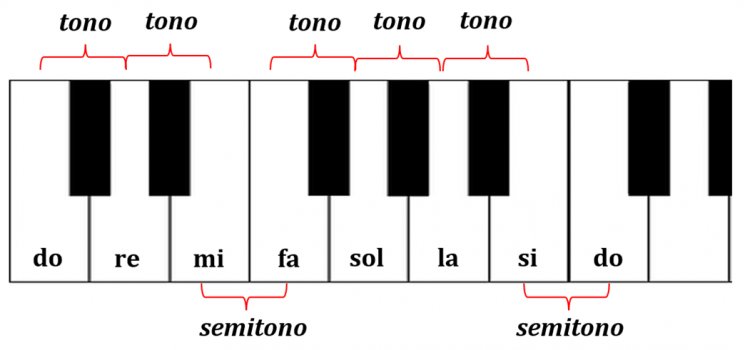
Whole tones: C-D; D-E; F-G; G-A; A-B
Semitones: E-F; B-C
Both distances become clear when you start learning a string instrument such as the violin, viola, or guitar, among others in the string family. You'll notice that whole tones and semitones span different distances. To play a whole tone, you need to spread your fingers apart, whereas to play a semitone, your fingers should be close together.
Accidentals
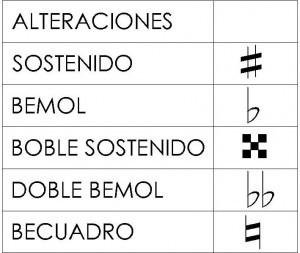
The notes mentioned above aren't always in their natural state; sometimes their pitch can change. This is the work of accidentals, which are defined as symbols capable of altering the pitch of musical notes.
There are three types of accidentals, which are as follows:
- Sharp: raises the pitch of the note by a semitone.
- Flat: lowers the pitch of the note by a semitone.
- Natural: cancels the effect of a sharp or a flat.
These symbols should be placed in front of the notes, on the same line or space where they're written. If the same note is repeated within the same measure, it must also be played with the same accidental; in the following measure, the effect no longer applies, meaning the note returns to its natural pitch.
Other accidentals are the following:
- Double sharp: raises the pitch of the note by a whole tone.
- Double flat: lowers the pitch of the note by a whole tone.
With each article, you'll keep gaining new knowledge that's valuable for learning any musical instrument. So my advice is to never stop practicing music theory, and never stop reading these articles.