Piano Chord Inversions: Part One

Do you know what piano chord inversions are? This is without a doubt one of the best technical tools that professional pianists can have.
Every classical piano or digital keyboard student should learn about piano chord inversions. That's why, this time around, we'll explain how they're built, what they look like, and all of the major chord inversions.
Let's get started!
Why piano chord inversions matter
Why are they important? For so many reasons. In terms of technique, inversions refine your playing and make it more elegant.
They're also important for the harmonic richness they bring, because they don't sound the same. If you pay close attention to the sound, a chord in root position doesn't sound exactly the same as it does in its first, second, or third inversion.
Another reason is that they make it easier to move your hands across the keys. This makes your playing more fluid and dynamic, and the sound comes across less and less forced.
The theory behind piano chord inversions
A promise is a promise, so now we're going to explain how to build chord inversions on the piano.
A chord inversion is one that doesn't start on the root, but instead begins on one of the other notes that make up the chord.
For example, if the C major chord is built from the triad C - E - G, then its first inversion shouldn't start on C, but on E, and the order of the notes would be E - G - C.
The goal is for the essence of the chord to stay intact, while adding a tonal variation that gives the sound greater harmonic richness.
The first chord inversions
From here on, we'll begin with piano chord inversions for the major keys, and in the next part we'll move on to the minor keys.
Major keys
Major keys are built from the triad of the root, the major third, and the perfect fifth. Therefore, the seven major chords are made up of the following notes:
- C: C - E - G
- D: D - F# - A
- E: E - G# - B
- F: F - A - C
- G: G - B - D
- A: A - C# - E
- B: B - D# - F#
This means that the first inversion of the chord doesn't start on the root, but on the major third. The second inversion begins on the perfect fifth, and that's how we'd have three different ways to play the same chord.
With extended chords, we have three and even four inversions on the piano. The reason is that there are more notes involved in building those chords.
So the inversions of the major chords would be:
- C: first inversion E - G - C, second inversion G - C - E.
- D: first inversion F# - A - D, second inversion A - D - F#.
- E: first inversion G# - B - E, second inversion B - E - G#.
- F: first inversion A - C - F, second inversion C - F - A.
- G: first inversion B - D - G, second inversion D - G - B.
- A: first inversion C# - E - A, second inversion E - A - C#.
- B: first inversion D# - F# - B, second inversion F# - B - D#.
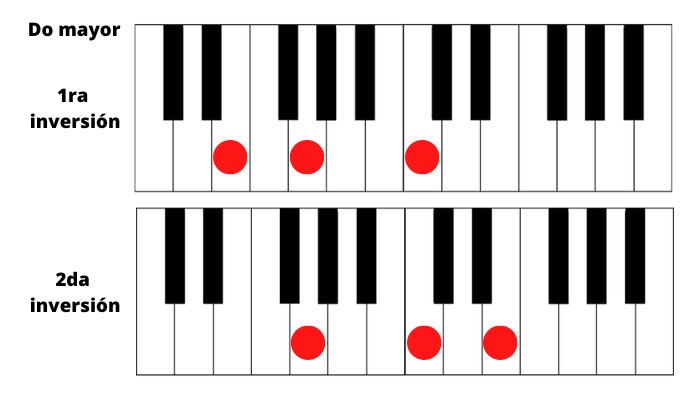
There you have it—you now have the first building block for playing piano chord inversions in major keys.
Remember that you can always reach out with your questions and we'll get back to you.