How to Conduct the Different Time Signatures?
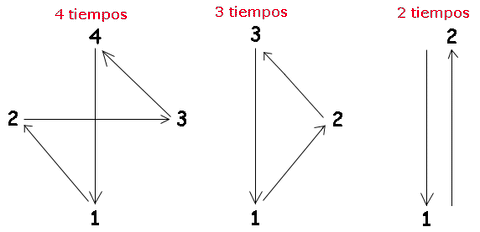
Once you've mastered time signatures and learned how to identify the beat unit and the measure, it's time to put theory into practice. When it comes to sight-singing, it's important to know that each time signature is conducted differently with the hands—both to respect the different beats and to land them on the exact pulse.
This is a hugely important technique when learning music. To learn it properly, keep reading the lines below.
How Are the Beats Conducted?

As mentioned in the introduction, the beats are conducted with the hands—specifically by snapping the fingers. To do this, the hands should move down, up, or to the sides.
You perform this with a single arm, moving it in the directions I'll outline below and then snapping your fingers; that snap marks each beat.
Two-Beat Time Signatures
This is one of the simplest, since it's made up of just two beats: the first beat is conducted upward and the second downward. This pattern is used in time signatures like 2/1, 2/2, 2/4, or 2/8 (simple) and in compound meters such as 6/8, 6/4, 6/2, among others.
Three-Beat Time Signatures
Its three characteristic beats are conducted as follows:
The first beat goes down, the second to the right, and the third up. You should move your hands this way when the time signature is 3/1, 3/2, 3/4, or 3/8, and in compound meters such as 9/8, 9/4, 9/2, and so on.
Four-Beat Time Signatures
This one consists of four beats, conducted like this:
The first beat goes down, the second to the left, the third to the right, and the fourth up. This pattern is used for time signatures like 4/1, 4/2, and 4/4, as well as compound meters such as 12/8, 12/2, 12/4, or 12/16.
When you play any instrument, you should keep these same beats; in those cases, it's best to do so mentally, because tapping with your foot can break your concentration—and if you're playing in an ensemble, it could even throw off the other players.
What About the Rests?
Rests, or full measures of inactivity within a piece, also need to be counted in order to keep the music flowing. When you write them out, keep these rules in mind:
If it's just a single measure of brief inactivity, simply drawing a whole-measure rest will do.

But if the rest lasts longer than one measure, you should use a symbol drawn with a thick horizontal line and two smaller vertical lines on either side; the number of measures to remain silent is written just above the staff.

From an orchestral or ensemble standpoint, it's important to respect—and to count—those measures of rest, because during them other instruments may have an important part to play.
Finally, measures can be conducted slowly or quickly depending on the various markings that appear at the beginning of the melody. This subject is known as tempo, and you'll learn all about it in the next article.