Dynamics, Breath, or Movement (Part 1)
Everything in life has its ups and downs, and music is no exception to this rule. If every sound were played at the same intensity or speed, music would be monotonous and would lose the appeal it holds today. That is why there is a wide variety of dynamics expressed through symbols.
These symbols, written using Italian words, are placed at specific points in the score to indicate that sounds should be played louder, softer, more intensely, and so on. To learn what the different dynamics in music are, as well as their functions and importance, be sure to read this article.
What Are Dynamics?
Dynamics are the different degrees or levels of intensity that one or more sounds, a passage, or an entire piece of music can pass through. These dynamics can relate to volume or to speed.
Volume Dynamics
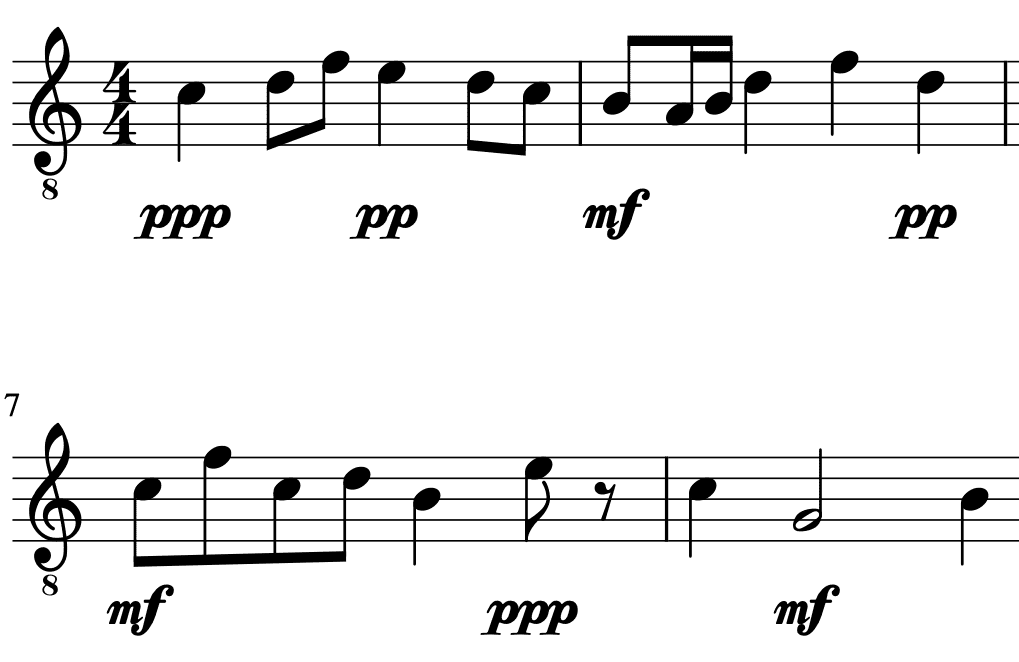
These are terms used to indicate a specific intensity of sound. Each of the terms explained below has been in use since the Classical period (the second half of the 18th century), with the aim of helping the performer achieve an interpretation closer to the composer's intention.
The volume dynamics are as follows:
Pianissimo: Its abbreviation is pp. Pianissimo calls for a softer intensity than piano. In the 19th century, this was the most common marking used to indicate a softer intensity; three p's (ppp) were also used to tell the performer to play as softly as possible. It is worth noting that in the 20th century you could even find more than four p's (pppp).
Piano: This is an Italian word meaning soft, and its abbreviation is p. The intensity indicated by piano is greater than that used for pianissimo but softer than that of mezzo-piano.
Mezzo-piano: Sounds with this marking should be moderately soft, and it is indicated by the letters mp. The intensity indicated by mezzo-piano is greater than that of piano and softer than that of mezzo-forte.
Mezzo-forte: In contrast to the previous term, mezzo-forte means moderately loud, and it is written with the letters mf. The intensity indicated by this marking is greater than that of mezzo-piano and softer than forte.
Forte: This means loud, and its abbreviation is f. Its intensity is greater than that indicated by mezzo-forte and softer than that of fortissimo.
Fortissimo: A sound marked with this indication should be very loud, and its abbreviation is ff. The intensity indicated by fortissimo is greater than that of forte. On some occasions three f's (fff) are added, which indicate that the sound should be even louder than fortissimo.
In scores, these markings appear in abbreviated form above the staff, precisely above the note where the dynamic begins.
In the second third of the 18th century, the marking affected only the phrase or motif in question; in other words, if a measure carried a forte marking, it applied only to the indicated note or measure.
But from the late 18th century to the present day, the performer must maintain it until a new dynamic marking appears.
Other Dynamics
The intensity of one or more sounds can be gradually increased or decreased at a given moment, and the following terms are used for this purpose:
- Diminuendo (Dim.) = Decreasing
- Calando (Cal.) = Decreasing
- Smorzando (Smorz.) = Fading the sound away little by little
- Morendo (Mor.) = Decreasing both movement and strength
- Perdendosi (Perd.) = Losing the sound.
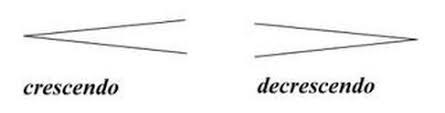
From this list, I left out two signs that are the best known when it comes to dynamics, and these are:
Crescendo
This sign is drawn just like the less-than symbol, but a bit larger. With this dynamic, the notes within it are instructed to grow gradually louder until, at a certain point, those sounds become very loud.
Decrescendo
It is drawn just like the greater-than symbol. By means of this dynamic, the notes of a given passage are instructed to grow gradually softer until they are almost imperceptible.
It is worth mentioning that, in both cases, the dynamic must be maintained until one of the markings mentioned earlier is placed.
Finally, it is important to observe all the dynamics that are marked in order to ensure the perfection of the piece. But that is not all—this topic will continue in the next article.
2 Comments