Tonality
Now that we have a grasp of intervals, another topic of great importance in music is tonality. It can be described as the set of rules that govern how scales are built.
Keep in mind that C is not the only scale that exists; everything would be far simpler if that were the case, but the truth is that there is a whole world of keys thanks to sharps and flats. To learn how these keys are named, as well as what the degrees of the scale are, be sure to read this article.
Key Signature
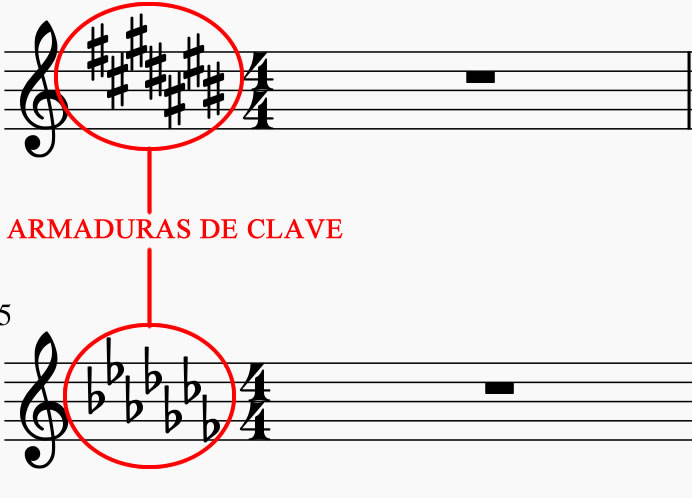
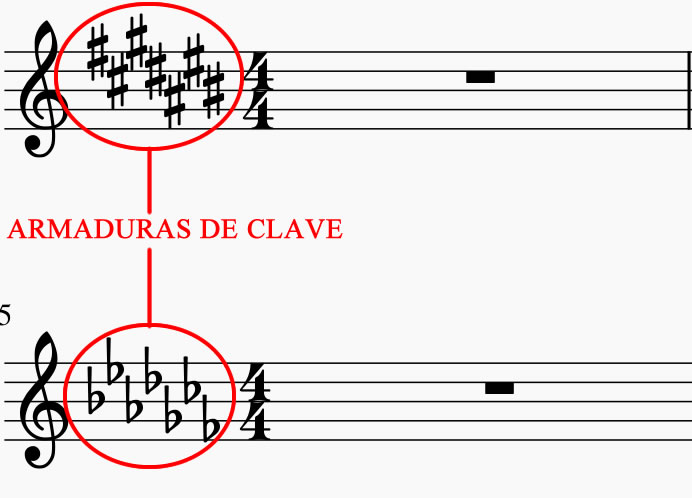
A key signature can be defined as the set of accidentals (sharps or flats) placed right after the clef. Its purpose is to indicate the key in which a scale or piece of music should be read. To understand key signatures, you need to know a few rules:
Key Signatures with Sharps
Sharps are placed in the following order: F-C-G-D-A-E-B. To find the name of a key whose signature is full of sharps, add a minor second above the note of the last sharp. For example, if the last sharp is F, the key of the scale will be G major. In this key, the note F will always be sharped. The same procedure applies to the rest of the sharps.
Key Signatures with Flats
Flats go in the reverse order of the sharps, that is, B-E-A-D-G-C-F. When it comes to naming the key, flats work a little differently, because the key takes its name from the second-to-last flat in the signature. In other words, if the signature contains B-flat and E-flat, the key is named B-flat major. When the only flat in the signature is B-flat, the key is automatically F major.
Degrees of the Scale
.gif)
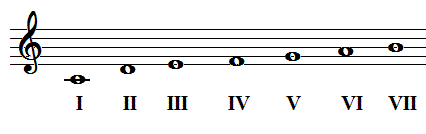
The degrees, or different notes that make up a scale, each have their own name, which I'll list below. Each one serves a distinct function within this succession of sounds, regardless of whether the scale is major or minor.
- First degree: the tonic is the note that gives the scale its name, as well as the key. For example, if C is the tonic, we are most likely in the scale of C major or C minor; either mode will be determined precisely by the key.
- Second degree: the supertonic
- Third degree: the mediant. It is considered important because it sits very close to the dominant and helps form the perfect chord of the scale, which is made up of the tonic, the dominant, and of course the mediant just mentioned.
- Fourth degree: the subdominant. This degree helps reveal the mode of the key; in other words, its sound is key to determining whether the scale is major or minor.
- Fifth degree: the dominant. It is the second most important note after the tonic, since its sound is essential for determining the key you are in. In the case of the major scale, G is another note of great importance after the tonic; if you hear that note on its own, you'll know you are in the key of C.
- Sixth degree: the submediant
- Seventh degree: the leading tone. It tends to resolve back to the tonic, since only a diatonic semitone separates it from it.
- Eighth degree: the tonic. It must be the same as the first degree, but an octave higher, marking the end of the scale.
As you can imagine, this topic cannot be covered in a single article, which is why I invite you to read my upcoming installments.