Time Signatures and Meter (Part 2)
When it comes to reading music, both time signatures and the meter they indicate are absolutely essential, so we can't afford to gloss over them. That's why we've put together a second article in which you'll learn additional concepts and easy ways to understand time signatures. If you want more information on the subject, be sure to read on.
Is there a relationship between simple and compound meter?
Every simple meter has a compound counterpart, and to find it, all you have to do is add a dot to the beat unit of the simple meter.
Let's explain this with an example: the 2/4 time signature is counted as two quarter-note beats. To find its compound counterpart, you add a dot to the quarter note. The counterpart will then be 6/8, which is counted as two dotted-quarter-note beats.
Another approach that leads to the same result is to multiply the numerator by three and the denominator by two; both operations give you a compound meter. For example, multiplying 2/4 by 3/2 gives you a 6/8 time signature.
You can also do the reverse, that is, find the simple counterpart of a compound meter. To do this, divide the compound time signature by the same fraction mentioned in the previous paragraph (3/2).
For example: if we have 9/4, which is counted as three dotted-quarter-note beats, but we want to know its simple counterpart, we divide it by 3/2. In this case, the result is the same number; keep in mind that this time signature is counted as three half-note beats.
Are there only meters with two, three, and four beats?
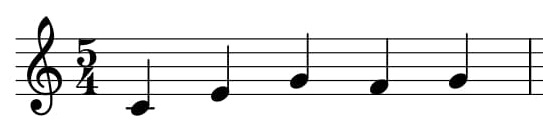
After researching extensively or reading this article, you're probably wondering whether there are meters with more beats; the answer is YES. There is a five-beat meter, known as an irregular or composite meter, which is built by combining a three-beat meter with a two-beat meter.

It's worth noting that there aren't only five-beat meters; you can also combine a four-beat meter with a three-beat one to get a seven-beat meter, or even a four-, three-, and two-beat meter to get a nine-beat meter.
Like any time signature, these are written at the beginning of the piece. There are two ways to do this: the first is to write the total number of beats in the numerator and the note value equivalent to one beat in the denominator; this way, the signature would be 7/4, which would be counted as seven quarter-note beats. Alternatively, the different meters can be written separately, using dotted barlines to ensure the exact number of beats is notated and to show the reader where the strong beats fall.

There are melodies that may call for these meters, but they aren't the norm. Still, it doesn't hurt to learn a little about them, so they'll look familiar when you come across them.
The beats
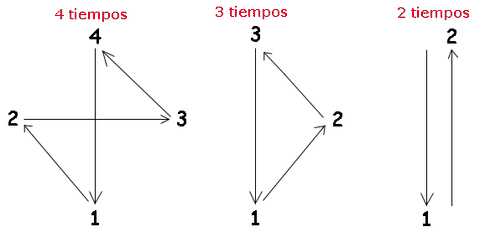
As mentioned earlier, meters have two, three, or four beats, regardless of whether they are simple or compound. Each of these meters has strong and weak beats, meaning that some should be articulated more forcefully than others.
With that in mind, it's important to remember that the strong beats are always the first and third, while the weak beats are the second and fourth. This rule applies in the following cases:
- In a two-beat meter: the first beat is strong and the second is weak.
- In a three-beat meter: the first beat is strong, the second is weak, and the third is strong.
- In a four-beat meter: the first and third beats are strong, while the second and fourth are weak.

In turn, each of these beats can be subdivided and accented the same way. In this sense, the first pulse would be strong and the rest would be weak.