The Major Harmonic Function

Do you know what the major harmonic function is? We've already covered the basics of building guitar chords and shown you how to take them all the way to their most advanced forms.
Now the time has come to explain everything about the major harmonic function. Our goal is for you to be able to build these chords yourself, so that together with chord construction you'll have the most solid foundation possible for writing your first compositions.
So don't miss anything we're about to explain about the major harmonic function. From this point on, you'll stop being a beginner on the guitar.
What is a harmonic function?
A harmonic function is a series of chords that work together within the same key. In other words, it's all the chords you can play when you're working in a given key, and they'll sound harmonious together.
The theory behind harmonic function
In theory, harmonic function tells us that the chords in a given key are as follows:
- The tonic is a major chord.
- The second is a minor chord.
- The third is a minor chord.
- The perfect fourth is a major chord.
- The perfect fifth is a major chord.
- The sixth is a minor chord.
- The seventh is a minor seventh flat five (half-diminished) chord.
This function means that if we write out the C scale, all we have to do is add the harmonic quality to each note.
So, to build the harmonic function of a major key, we first write out the natural scale and then add the harmonic quality that corresponds to each degree.
Building our first harmonic functions
Now we're going to build the major harmonic function for each key, which will give us the chords that work together in each one.
The steps are the same in every key: first we write out the scale and then we add the harmonic quality that corresponds to each degree:
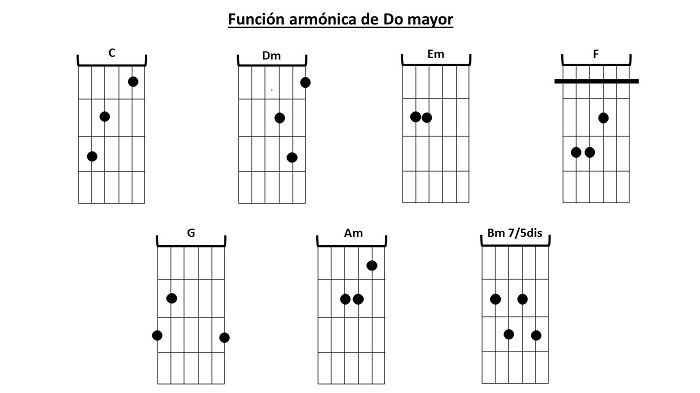
Harmonic function of C
The C major scale is:
- C - D - E - F - G - A - B.
Now we add the harmonic quality to each degree of the scale:
- C major.
- D minor.
- E minor.
- F major.
- G major.
- A minor.
- B minor seventh flat five.
In this first run-through we wrote out the chord name along with its harmonic quality next to each one. However, when a chord is major, we don't write "major"; we just write the chord name and it's understood to be major.
Harmonic function of D
We write out the D major scale in standard notation:
- D - E - F# - G - A - B - C#.
Now we add the major harmonic function:
- D.
- Em.
- F#m.
- G.
- A.
- Bm.
- C#m 7b5.
Harmonic function of E
We write out the E scale in its major form with its natural sharps.
- E - F# - G# - A - B - C# - D#
Now we move on to the major harmonic function:
- E
- F#m
- G#m
- A
- B
- C#m
- D#m 7b5
Harmonic function of F
We'll keep writing out the scale of each key so you get plenty of practice with it, and remember that F carries the natural accidental of B flat.
- F - G - A - Bb - C - D - E
So the major harmonic function of F is as follows:
- F
- Gm
- Am
- Bb
- C
- Dm
- Em 7b5
Harmonic function of G
The G scale carries one natural accidental:
- G - A - B - C - D - E - F#
Its major harmonic function would be:
- G
- Am
- Bm
- C
- D
- Em
- F#m 7b5
Harmonic function of A
The A scale has three natural accidentals:
- A - B - C# - D - E - F# - G#
Its harmonic function is as follows:
- A
- Bm
- C#m
- D
- E
- F#m
- G#m 7b5
Harmonic function of B
The B scale carries four natural accidentals:
- B - C# - D# - E - F# - G# - A#
Its harmonic function is as follows:
- B
- C#m
- D#m
- E
- F#
- G#m
- A#m 7b5
If you'd like a downloadable file with the guitar chords for each major harmonic function, feel free to write to us and ask us to send it to your email.
1 Comments