Analysis of the Venezuelan Waltz "Natalia": Antonio Lauro

The Venezuelan waltz "Natalia" is, to this day, required study repertoire in classical guitar programs at conservatories all over the world.
For many, it's the final piece you must conquer to pass your first year. At other music schools, it isn't tackled until the second year of guitar study.
The truth is that, whatever your country, if you set out to study classical guitar, the Venezuelan waltz "Natalia" will be one of your trials by fire, the moment to prove what you're made of and whether you've truly earned the right to move forward.
Alirio Díaz or Antonio Lauro? The true composer of the Venezuelan waltz "Natalia"
Even in Venezuela it's quite common to hear people refer to "Natalia" by Alirio Díaz, so it's no surprise that in other countries people also believe this piece was written by that wonderful performer.
The truth, however, is that the real composer of the Venezuelan waltz "Natalia" is the legendary Antonio Lauro, a native of the state of Bolívar. This outstanding musician is regarded not only as the finest in Venezuela, but as one of the finest of the 20th century.
His works gained worldwide recognition thanks to composers and performers such as Andrés Segovia, John Williams, Leo Brouwer, and Alirio Díaz, who added them to their repertoire.
So let's get to know this piece for guitar that will undoubtedly enrich your musical repertoire and earn you plenty of applause.
The tempo of the Venezuelan waltz "Natalia"
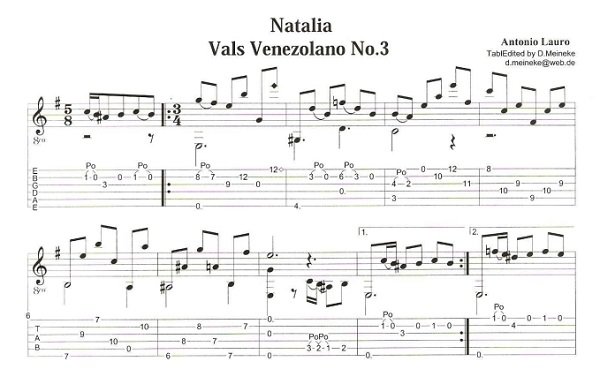
As you'd expect, the Venezuelan waltz "Natalia" sits in a waltz tempo at 60 bpm, in 3/4 time with eighth notes as the predominant subdivision.
If you aren't yet familiar with the Venezuelan waltz, it's a bit tricky to explain and you really need to hear it, because it is written in 3/4 but is played as though you were reading 6/8.
On top of that, it opens with a little bonus: the entrance in the first measure begins with a pickup in 5/8 time, accenting the second eighth note of the first beat, which is split into two sixteenth notes.
This is exactly where the rhythmic complexity of the Venezuelan waltz "Natalia" comes from, because it not only forces you to read in one meter while playing in its subdivision, but also requires you to nail that opening pickup.
For that reason, the first-year student's musical ear must be well trained and their sight-reading has to be fluent in order to perform this contemporary guitar piece.
The harmony of the Venezuelan waltz "Natalia"
This piece is made up of three movements that stand out for their harmonic variation, rich in tonal color. It also follows the strict principles of the Venezuelan waltz.
First movement
The first movement of the Venezuelan waltz "Natalia" is in the key of E minor and moves through its harmonic functions so that the future guitar master can show off their command of musical form.
What's more, the chord shapes called for here are anything but conventional, giving the student the chance to demonstrate just how much technical skill they have.
Second movement
In this movement there's a significant change in the way the strong beat of each measure is marked, and it becomes a heavily accented waltz tempo.
In addition, it employs a compositional technique known as crab canon, or mirror harmony, which enriches the piece musically.
Third movement
In the third movement of the Venezuelan waltz "Natalia" there's a tonal modulation, as it shifts from E minor to E major, giving it the sound of a thoroughly classic waltz.
The aim of this harmonic variation is to let the player show how well they command the classic waltz tempo. On top of that, the chords call for some fairly demanding stretches, since they're open voicings.
In this way, the form of the Venezuelan waltz "Natalia" masterfully addresses four elements, namely: 1. Rhythmic variations, 2. Harmonic modulations, 3. Compositional techniques, and 4. Skill in performance.
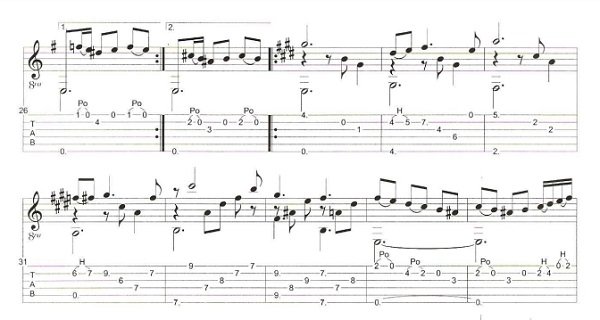
Remember that we've made the PDF file available for free download, with the sheet music for this guitar piece.