Guitar Chords for Beginners: Part 1

Every beginner dreams of playing their first guitar chords for beginners and finally getting to perform their first song.
From major and minor guitar chords to added second and fourth chords, these are appealing shapes that every newcomer wants to learn.
For that reason, this time we'll explain how these shapes are built so you can do it on your own and become an expert.
Building Basic Chords
Since this is the first part of building chords for beginners, we'll look at five shapes you're sure to love. That way, you'll start adding tools to your guitar repertoire.
It's worth noting that these guitar chords for beginners work for classical, electric, and steel-string acoustic guitar.
The Guitar Fretboard
The first thing you need to know in order to build guitar chords as a beginner is the guitar fretboard and where the musical notes sit all the way along it.
For example, if the strings are named E, A, D, G, B, E, then, following the rule of sharps, we get the following order of notes on each string and fret:
- Low E (6th string): F-T1, F#-T2, G-T3, G#-T4, A-T5, A#-T6, B-T7, C-T8, C#-T9, D-T10, D#-T11, E-T12.
- A: A#-T1, B-T2, C-T3, C#-T4, D-T5, D#-T6, E-T7, F-T8, F#-T9, G-T10, G#-T11, A-T12.
- D: D#-T1, E-T2, F-T3, F#-T4, G-T5, G#-T6, A-T7, A#-T8, B-T9, C-T10, C#-T11, D-T12.
- G: G#-T1, A-T2, A#-T3, B-T4, C-T5, C#-T6, D-T7, D#-T8, E-T9, F-T10, F#-T11, G-T12.
- B: C-T1, C#-T2, D-T3, D#-T4, E-T5, F-T6, F#-T7, G-T8, G#-T9, A-T10, A#-T11, B-T12.
- High E (1st string): F-T1, F#-T2, G-T3, G#-T4, A-T5, A#-T6, B-T7, C-T8, C#-T9, D-T10, D#-T11, E-T12.
When you see T followed by a number, that means the number of the fret where that musical note is located.
The other thing you need to keep in mind is the scale degrees, which are counted as follows:
- Diminished second: one semitone from the root.
- Second: two semitones away from the root.
- Minor third: three semitones from the root.
- Major third: four semitones from the root.
- Perfect fourth: five semitones from the root.
- Diminished fifth: six semitones from the root.
- Perfect fifth: seven semitones from the root.
Your First Chords
Now let's get into the first five guitar chord shapes for beginners that are the most commonly used.
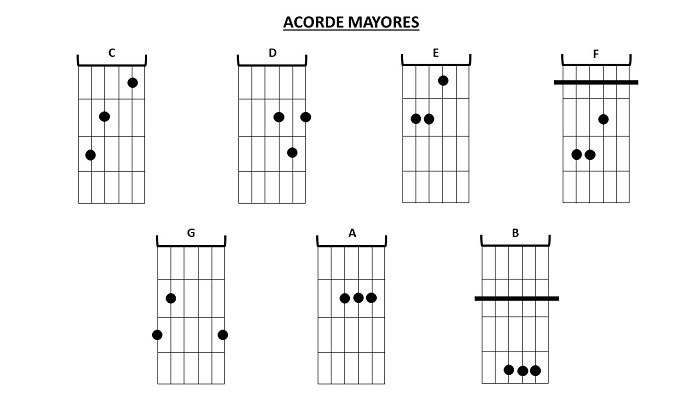
Major Chords
These chords are built by combining three degrees, namely the root, major third, and perfect fifth.
So, if we take the C chord as an example, we have the scale:
C - C# - D - D# - E - F - F# - G - G# - A - A# - B
This way, to play the C major chord, you need to combine the notes C - E - G.
Minor Chords
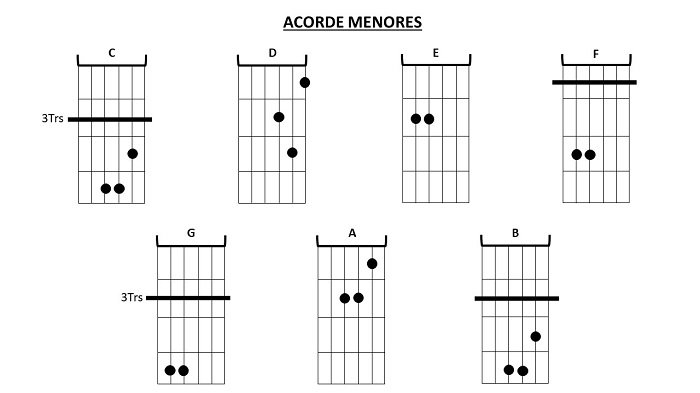
They are very similar to major chords, but the third is no longer major, it's minor and it's obtained as follows:
C - C# - D - D#/Eb - E - F - F# - G - G# - A - A# - B
2dim Chords
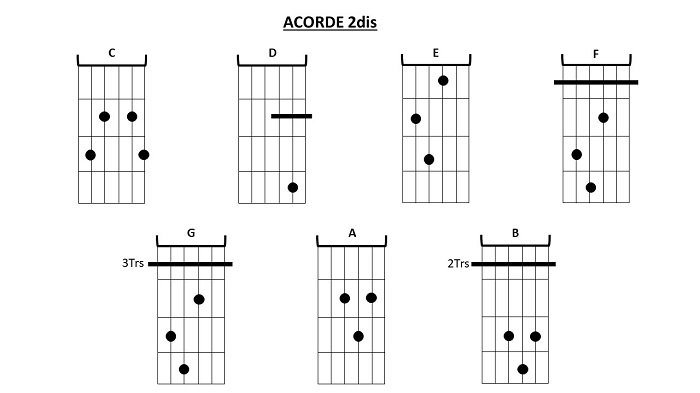
In these chords the third degree is left out, and in its place the diminished second degree is added, a half step up:
C - C#/Db - D - D# - E - F - F# - G - G# - A - A# - B
That said, in some cases it's possible to keep the major third degree and still add the diminished second degree.
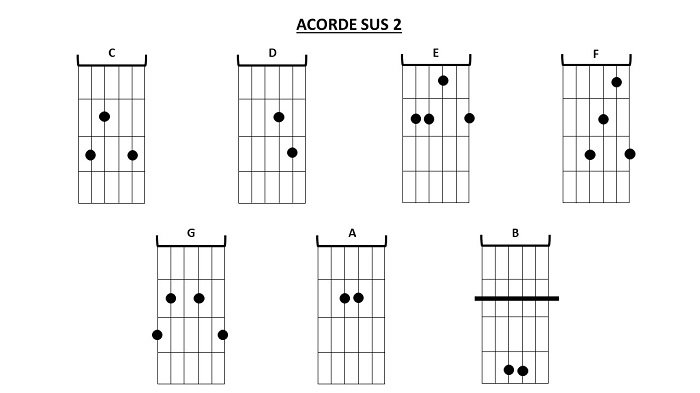
Sus2 Chords
For these chords the second degree is not diminished; instead it stays in its natural state, two semitones from the root, and is built as follows:
C - C# - D - D# - E - F - F# - G - G# - A - A# - B
Sus4 Chords
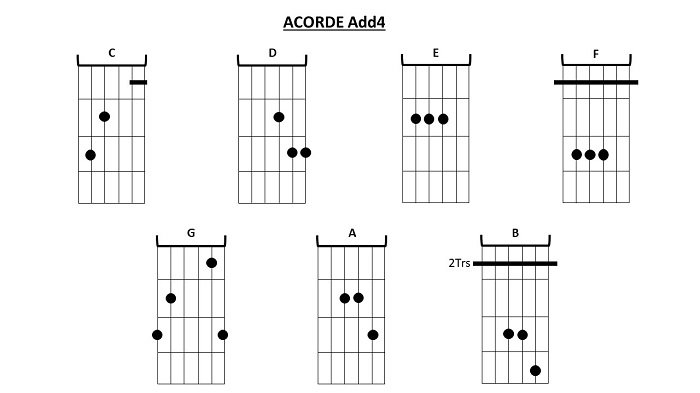
If you want to play these chords, you need to combine the root, perfect fourth, and perfect fifth. This way you can play a Sus4 chord that is considered a transition chord, or a fourth-over-third chord in musical composition.
C - C# - D - D# - E - F - F# - G - G# - A - A# - B
It's worth noting that in some methods you'll see this chord written as add4.
Remember that you can download the PDF file containing all the chords explained in this article.