The Chord
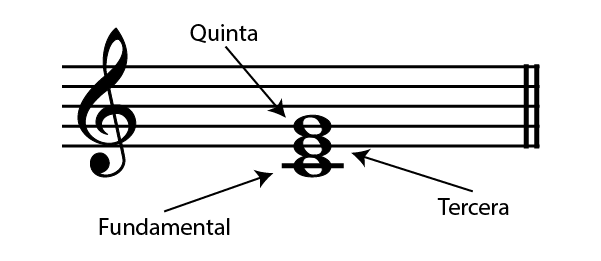
A chord consists of three notes stacked in thirds that sound at the same moment. This type is known as a triad, and it is the smallest representation of a scale, since its three pitches correspond to the tonic, mediant, and dominant—the fundamental tones used to recognize a major or minor scale.
Just like intervals, chords can be major, minor, augmented, or diminished depending on how they are built.
For this reason, studying and understanding them is vitally important, but don't worry: if you've grasped the topic of intervals, chords will come easily. It's just a matter of practice.
For more information about the chord and its inversions, be sure to read this article.
How are chords built?
The root note is the most important one, because it is what gives the chord its name. The other two thirds are then stacked on top of this root note.
The note above the root sits a third away, and together with the next one it forms an interval of a fifth. Let's understand this better with an example: to build the C chord, we place this first note and then immediately add E (the third) and G (the fifth).
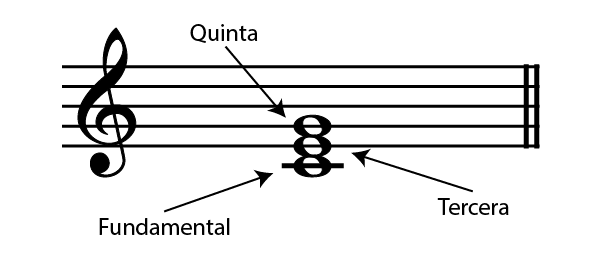
Classification and structure
The chord's "last name" (major, minor, augmented, or diminished) is determined by its internal structure.
- A major chord is made up of a major third followed by a minor third.
- A minor chord is made up of a minor third followed by a major third.
- An augmented chord has two major thirds.
- A diminished chord has two minor thirds.
Both major and minor chords feature a perfect fifth, which is the distance between the first and last note of the chord. As their names suggest, diminished chords have a diminished fifth, while augmented chords have an augmented fifth.
For example, the C major chord is made up of a major third and a minor third, which is precisely why it turns out to be a major chord.
When writing them down in an identification exercise, you should write the letter name of the note followed by one of these labels:
- M = to indicate that it is major
- m = to indicate that it is minor
- A or Aug = to indicate that it is augmented
- dim = if it is diminished
This way, the chord will be completely identified.
Inversions of triad chords
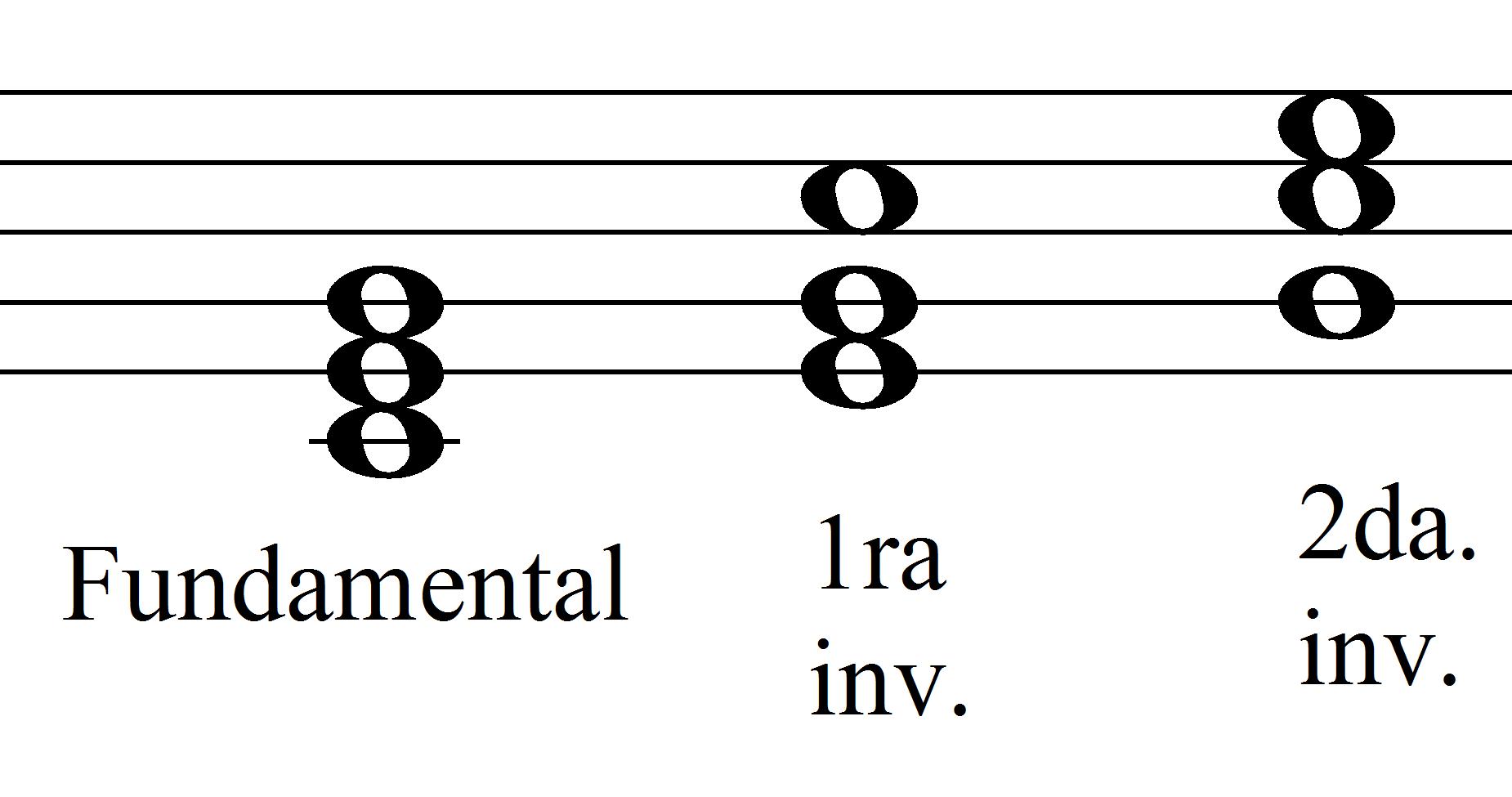
A triad has two inversions in addition to its root position, and you can spot them when either the fifth or the third is in the bass.
- Root position: the tonic is in the bass.
- First inversion: a triad is in this inversion when the third is in the bass. It is indicated with the figured bass 6/3.
- Second inversion: a triad is in this inversion when the fifth is in the bass. When writing it down, it is indicated with the figure 6/4.
To write the C major chord in first inversion (6/3), you need to place the note E in the bass, followed by G and then C in the third space; but you can't leave the chord in that position—if an exercise asks you to, you'll need to return it to root position. To do that, place the upper C on the first ledger line below the staff, which is where it belongs.
Likewise, to write the same chord in second inversion (6/4), you leave the note G (the fifth of the chord) in the bass, followed by C in the third space, forming an interval of a fourth, and E in the next space, with which it forms an interval of a sixth. If you want to return this chord to root position, you can write G on the ledger space, or place C and E in their central positions (the first ledger line below the staff and the first line, respectively).
When identifying them, you should write the name of the chord, the labels mentioned earlier, and the figures 6/3 or 6/4 if they are inverted.
There are also seventh chords, or tetrads, which consist of four stacked pitches; we'll get to know those in the next article.