The Basics of Music Theory (Part 3)
Some concepts in music are so complex that they can't be covered in a single article. That's why we've decided to break the subject down into separate installments, making it far easier to understand.
In this third installment, you'll find more information about tones, semitones, and enharmonics, and on top of that, we'll begin to explore a topic of great importance in music: intervals.
More on the Tone and the Semitone
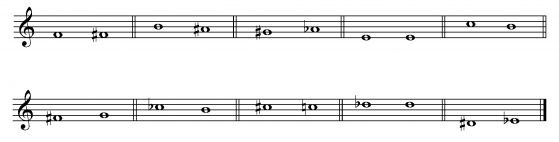
There are two kinds of semitone: diatonic and chromatic. The first occurs between two adjacent notes that have different names (for example: E–F). The second occurs between two notes of the same name, where one of them has been altered (C natural and C#).
This means a whole tone is made up of two semitones: one chromatic and one diatonic. From C to D there is a whole tone, but to reach D you have to pass through C#. So the chromatic semitone lies between C and C#, while the diatonic semitone runs from C# up to D.
Enharmonics
Now that we understand accidentals, as well as diatonic and chromatic semitones, it makes sense to talk about enharmonics. This is the term for two notes that have different names but produce the same pitch. For example, C# and D-flat, or E and F-flat, among others. Individually, these are also called enharmonic notes.
Intervals
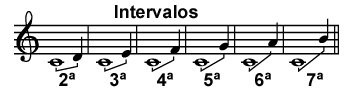
Now let's add a new concept to our list. This is a key foundation of music theory, because music itself is made of intervals. An interval is defined as the distance between two notes.
Intervals can be ascending or descending, and simple or compound—but let's take it one step at a time.
An interval is said to be ascending when it's read from the lower note up to the higher note, and descending when it's read from the higher note down to the lower one.
How Many Intervals Are There?
The truth is that they're infinite—there appears to be no limit to the distances. However, to make things a little easier, music theorists have chosen to classify them from the second up to the tenth. So let's define each one:
- Second: the distance spanning two scale degrees* (C–D)
- Third: the distance spanning three scale degrees (C–E)
- Fourth: the distance spanning four scale degrees (C–F)
- Fifth: the distance spanning five scale degrees (C–G)
- Sixth: the distance spanning six scale degrees (C–A)
- Seventh: the distance spanning seven scale degrees (C–B)
- Octave: the distance spanning eight scale degrees (C to the C an octave higher)
- Ninth: the distance spanning nine scale degrees (C to the D an octave higher)
- Tenth: the distance spanning ten scale degrees (C to the E an octave higher)
* Scale degrees: a scale is made up of eight pitches, and each one represents a degree.
It's worth noting that intervals are simple if they fall within the range of a second to an octave, and compound from the ninth onward.
What About the Unison?
A unison consists of the same pitch sounded by different voices. Since there's no distance traveled—it's the very same note—the unison is not considered an interval.
What Happens Beyond the Tenth?
Of course there are elevenths, twelfths, thirteenths, and so on; it all depends on the melody or on the range of the instruments you're analyzing. But it's nothing you need to worry about right now.
As I mentioned, the subject of intervals is hugely important in music. It takes a lot of practice to master them completely; in the next installment we'll discuss how intervals are qualified and constructed.
Be sure to read every single one of these articles—I'm confident they'll help clear up any questions you might have about the various concepts in music.