The Basics of Music Notation (Part 1)
Music has many definitions. For some people it represents the art of combining different sounds, others define it as a language and a form of communication, while for others it is a science, given the precision required to play any melody. There are many ways to define music, but over time it is each musician who gets to write their own definition, depending on the feelings it stirs in them or the way they choose to perform it.
The French musician Adolphe Danhauser pointed out in his book on music theory that music has four main signs: notes, clefs, rests, and accidentals. Three of these fundamental building blocks of music will be covered in this article, so be sure to read on.
Note Values
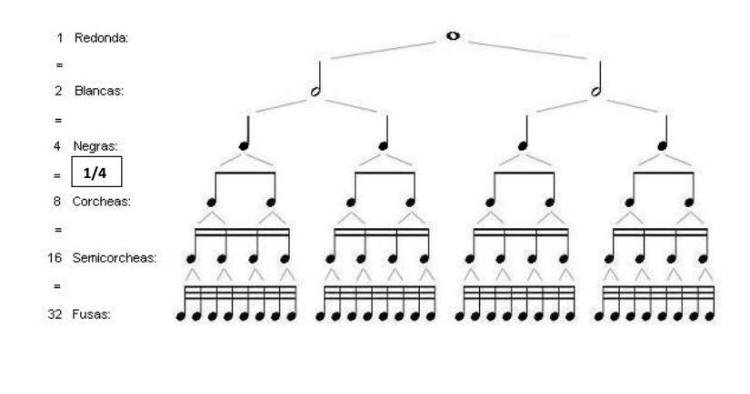
Note values are those “drawings or symbols” used to represent both rhythms and musical notes. Each one has a different duration:
- Whole note: worth four beats; it is the most familiar figure and the one with the longest duration.
- Half note: worth half the value of a whole note (2 beats).
- Quarter note: this note value is worth one beat.
- Eighth note: worth half a beat (two eighth notes make one beat).
- Sixteenth note: worth ¼ of a beat (four sixteenth notes equal one beat).
- Thirty-second note: its duration is 1/8 of a beat (eight thirty-second notes make one beat).
- Sixty-fourth note: worth 1/16 of a beat (16 sixty-fourth notes equal one beat).
Musical Notes
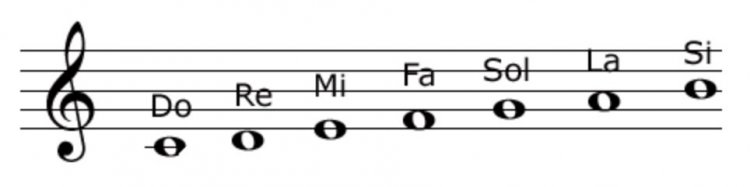
There are seven musical notes, and they are: DO, RE, MI, FA, SOL, LA, SI. They can also be written using letter names, in which each pitch is given a letter of the alphabet, as follows:
- C = DO
- D = RE
- E = MI
- F = FA
- G = SOL
- A = LA
- B = SI
The Staff
All of these notes and note values need to be written on a set of lines. Here, the staff will be that “notebook” on which our music is written. It gets its name from the fact that it is made up of five lines and four spaces.
How do you read these note figures?
To answer this question, we first need to talk about clefs. Clefs are those symbols placed at the beginning of the staff; their job is to indicate the position the note figures will occupy, which, from that moment on, become “musical notes.”
There are three types of clefs: SOL (treble), FA (bass), and DO (C clef). Each one is placed on different lines of the staff to mark different ranges.
The treble clef (SOL) is placed only on the first and second lines, the latter being the one most widely used by many instruments.
Likewise, the C clef (DO) is used on every line except the fifth, while the bass clef (FA) can be placed on the third or fourth line.
It is worth noting that the note written on the line where the clef sits automatically takes that same name. For example, if we read in treble clef on the second line, the note written on that line is called SOL (G).
This means that below SOL is FA, then MI, then RE, and on the first ledger line below sits DO.
Meanwhile, above SOL is LA, followed by SI and then DO, after which the sequence can continue with RE, MI, and so on. The same principle applies to the other clefs.
As you have surely realized, music cannot be learned from a single article, so I invite you to read my upcoming posts so you can learn everything about music notation in the easiest and most comfortable way possible.
1 Comments