Studying the Aria from Partita a-moll
The time has come to study the Aria movement of Partita a-moll, a piece generally regarded as beginner level yet one that holds a musical and interpretive depth only a mature musician can truly reach.
Right from the start you'll notice there isn't much rhythmic complexity, nor anything tricky in the shape of the chords, but if you pay close attention you'll come to understand where the real challenge of this lute piece, transcribed for guitar, actually lies.
Now, let's take a look at what Partita a-moll Aria by Johann Anton Logy is all about.
Johann Anton Logy
His full name was Johann Anton Losy von Losinthal, and he was considered one of the finest lutenist composers and guitarists of the Baroque period.
He stood out for his lute compositions, which he later transcribed for the guitar, and his work was of such high quality that he became a musician at the royal court.
At the same time, one important trait of his compositions is that he wrote all of his pieces in tablature. As a result, there is no single definitive way to perform his works today; only approximate records survive, set down in standard notation by Sylvius Leopold Weiss, among others.
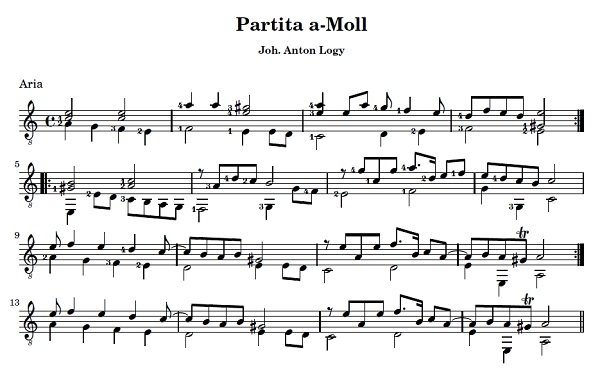
Partita a-moll Aria
In essence, this piece is made up of three movements that are clearly defined and easy to tell apart.
First movement
The Aria movement of Partita a-moll is built on the harmonic foundation of Am and follows a soft yet accented dynamic that should be kept in mind throughout the performance.
From the outset, the piece unfolds like a conversation in two voices between the middle and upper registers. Because of this, controlled movement of every finger is essential to achieve an even, cohesive performance.
The Am, E, C, and F chords, along with a few passing notes, are what make the first movement so rich in voices, giving the sound a round, full, and consistent quality.
Second movement
This movement opens on an E major chord and is meant to add depth to the composition. It also introduces quicker passages that, at certain points, call for a different tempo in performance, somewhat faster and more deeply felt.
In this way, the harmonic foundation moves through the chords E - F - G - A. As a result, Partita a-moll is played within the range of the guitar's first five frets.
For this reason, the guitarist needs to pay close attention to fingering and position and to everything that can be achieved simply by moving within this range of the guitar.
Third movement
The final movement signals its closing right from the start, opening on a two-note scale whose notes converse with one another in A minor. It then shifts to Dm to give a deeper sense of farewell between the notes.
E major sounds the final call, so that Am can have the last word and say goodbye.
Recommendations
It's very important to study the score carefully and find the most comfortable way possible to play it. On top of that, this piece should be understood as a conversation between two lovers parting ways, never to see each other again.
For that reason, the sound of this piece is melancholic, shy, yet accented so that the emotion truly comes across to the audience.
Remember to download the PDF and the MP3 audio so you have a solid visual and aural guide to follow.