Simple Intervals: Quality and Composition

To recognize an interval perfectly, you need to master its classification, quality, and composition—three concepts that can be tricky at first. In the previous article we covered classification, but now it's time to understand how each interval is qualified and built. This time we'll focus on simple intervals, and in upcoming posts we'll cover compound ones. So if you want to understand everything there is to know about intervals, be sure to read this article all the way through.
Quality of Simple Intervals
Once you've classified an interval, you need to determine whether it is major, minor, perfect, augmented, or diminished, depending on the number of whole tones and semitones separating the two notes. To find out which quality each one can take, keep reading the lines below:
- Second: can be major, minor, or augmented.
- Third: major, minor, augmented, or diminished.
- Fourth: perfect, augmented, or diminished.
- Fifth: perfect, augmented, or diminished.
- Sixth: major, minor, augmented, or diminished.
- Seventh: major, minor, or diminished. This is the only interval that cannot be augmented.
- Octave: perfect, augmented, or diminished.
Composition of Simple Intervals
After classifying and qualifying an interval, you need to know exactly how many whole tones and diatonic or chromatic semitones it contains.
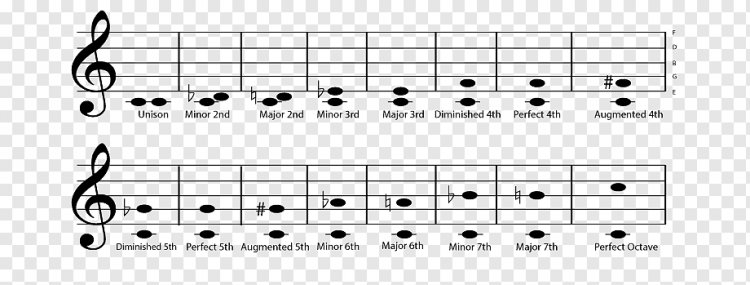
Composition of Seconds
Minor second: made up of one diatonic semitone. For example, E–F is a minor second.
Major second: made up of one whole tone. In this case, F–G is a major second.
Augmented second: one whole tone and one chromatic semitone. An example of an augmented second: C–D#.
A diminished second? The diminished second is an enharmonic equivalent, which is why it isn't considered an interval—it's the same sound spelled with two notes that have different names.
Composition of Thirds
Minor third: one whole tone and one diatonic semitone. An example of a minor third: C–Eb.
Major third: two whole tones, for example D–F.
Augmented third: two whole tones and one diatonic semitone (C–E#).
Diminished third: two diatonic semitones (C–Ebb).
Composition of Fourths
Perfect fourth: two whole tones and one diatonic semitone (C–F).
Augmented fourth: can be made up of two whole tones plus a diatonic semitone and a chromatic semitone, or of three whole tones (C–F#).
Diminished fourth: one whole tone and two diatonic semitones (C–Fb).
Composition of Fifths
Perfect fifth: made up of three whole tones and one diatonic semitone. Example: C–G.
Augmented fifth: three whole tones, one diatonic semitone, and one chromatic semitone. You could also say it's made up of four whole tones (C–G#).
Diminished fifth: two whole tones and two diatonic semitones (C–Gb).
Composition of Sixths
Minor sixth: three whole tones and two diatonic semitones (C–Ab).
Major sixth: four whole tones and one diatonic semitone (C–A).
Augmented sixth: four whole tones, one chromatic semitone, and one diatonic semitone (C–A#).
Diminished sixth: two whole tones and three diatonic semitones (C–Abb).
Composition of Sevenths
Minor seventh: four whole tones and two diatonic semitones (C–Bb).
Major seventh: five whole tones and one diatonic semitone (C–B).
Diminished seventh: three whole tones and three diatonic semitones (C–Bbb).
Composition of Octaves
Perfect octave: five whole tones and two diatonic semitones (C up to the C an octave higher).
Augmented octave: five whole tones, two diatonic semitones, and one chromatic semitone (C–C# in the higher octave).
Diminished octave: four whole tones and three diatonic semitones (C–Cb in the higher octave).
How Do You Memorize All of This?
After reading through all of these intervals, you're probably wondering: how can I master every one of these compositions, on top of the classification and quality of intervals?
The first thing you need is patience, along with daily practice. This information won't sink in overnight, so take your time. That said, there are several mnemonic tricks that can help you remember it all—and we'll cover those in a future article.