Seventh Chords: Tetrads or Four-Note Chords
Previously, we got to know triads, which are made up of two stacked thirds. It is worth remembering that each of their notes represents three important degrees within the scale: the tonic, the mediant, and the dominant.
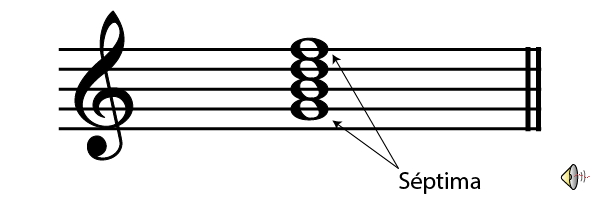
This time, we will be talking about tetrads, or four-note chords, because instead of three, there will be four stacked notes sounding at the same time.
To build one, you stack another third on top, which sits a seventh interval away from the root. That is exactly why the chord is known as a “seventh chord.”
To learn all the features of this important chord, I invite you to read this article.
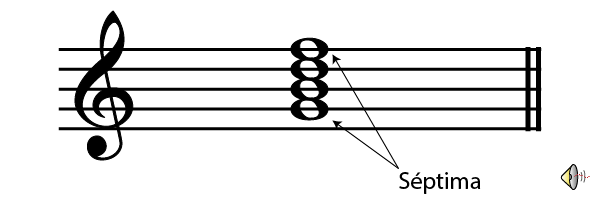
Types of Seventh Chords
Tetrad chords are classified as follows:
- Dominant seventh chord: one of the most common, thanks to its distinctive sound. It is built from a major chord plus a minor seventh. It is found on the fifth degree of the major scale.
- Major seventh chord: built from a major triad with a major seventh added on top, on the first, third, or sixth degree of the major scale.
- Minor seventh chord: in contrast to the previous one, this is built from a minor triad and a minor seventh.
- Half-diminished seventh chord: a diminished triad with a minor seventh; it is also known as the leading-tone seventh chord. It can be found on the seventh degree of the major scale.
- Diminished seventh chord: made up of a diminished triad and a diminished seventh; it is built on the seventh degree of the melodic minor scale.
Can these chords be inverted?
The answer to this question is a resounding YES: the position of the notes that make them up can be rearranged. It is worth pointing out that each seventh chord has different inversions, but for any seventh chord, the inversions are as follows:
Root position
If the chord is in none of these inversions, it is in root position, which means the root of that chord sits in the bass; this is written with the number 7. Let's explain it with an example: to build a C major seventh chord, you need to write the notes C-E-G-B. The notes mentioned above can be inverted in the following ways:
First inversion

You can spot this when the seventh sits on the fifth degree, forming a second with the note above it. This chord can be figured with the numbers 6/5/3 or 5/3. To invert the chord from the previous example, you place the seventh (the note B) at the bottom, and it then forms a second interval with the note C, ending up like this: E-G-B-C.
Second inversion

The seventh is on the third degree, forming a second with the note above it. It is figured with the numbers 6/4/3 or 4/3; you can recognize this inversion when the seventh is in the third of the chord, leaving the notes as G-B-C-E.
Third inversion
When the seventh is in the bass, it is figured with the numbers 6/4/2, 4/2, or simply 2. This way, we get the chord fully inverted, with the notes B-C-E-G.
The seventh is an appealing sound, capable of generating a tension that resolves to the tonic of a major or minor scale. For this reason, seventh chords are easy to recognize, especially dominant seventh chords, which is why studying them is so important.