Scale Basics and Rhythmic Note Values
For music to be performed successfully, you need both pitches and the various rhythmic note values. With that in mind, in this article we'll cover several fundamental concepts that play an important role in music education. So if you'd like to learn more, read on.
The scale we've studied previously is the diatonic scale, but I should also point out that there are other types of scales: the chromatic and the enharmonic.
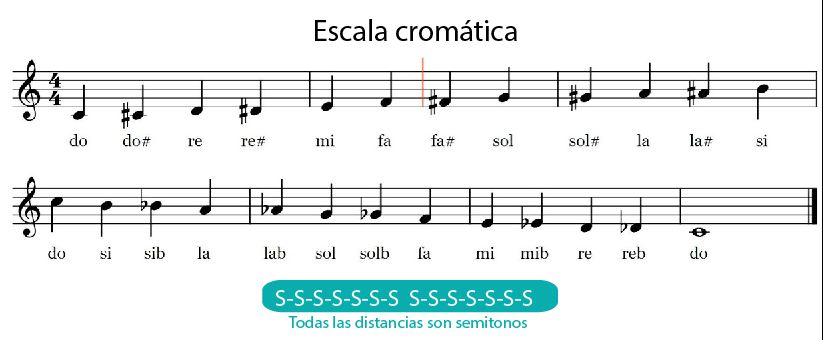
Chromatic scales

As its name suggests, the chromatic scale moves through every diatonic and chromatic semitone. Unlike the diatonic scale, it lets you hear all the intermediate pitches that lie between the different scale degrees. This scale contains seven diatonic semitones and five chromatic ones, twelve semitones in all.
It's worth noting that chromatic notes lend different colors to a melody; depending on the context, they can give it a certain firmness, though it's important to clarify that passing through them repeatedly does not imply any change of key.
Enharmonic scales
This is what we call two scales whose pitches are identical but whose notes are spelled with different names. A clear example of this is the scales of C# Major and Db Major; if you play both in succession, you'll notice that they sound exactly the same.
What is a tetrachord?

This is a very common term in musical terminology. Its origin lies in the joining of two Greek words: tetra, meaning four, and chordon, which refers to the word string. A tetrachord, then, is defined as a group of four notes within a scale.
Within a scale there are two tetrachords, which we'll call the lower tetrachord and the upper tetrachord. The first is made up of the four lowest notes of the scale, while the upper one contains the four highest notes.
In a scale, both tetrachords are identical in terms of how their pitches are built and arranged; both the upper and the lower tetrachord consist of two whole tones and one diatonic semitone.
Now let's look at some rhythmic concepts!
Lately we've focused only on pitches, setting the rhythmic side aside, but don't worry; this time we're going to come back to it and discuss concepts that are tremendously important for every musician.
Earlier we talked about note values, rests, and other rhythmic elements. There are, however, additional symbols that extend the value of note figures.
One of them is the dot: a dot placed after any note in order to lengthen its value.
Here are the durations that dotted notes would have:
- Dotted whole note: six beats
- Dotted half note: three beats
- Dotted quarter note: a beat and a half
- Dotted eighth note: equals one eighth note plus three sixteenth notes.
- Dotted sixteenth note: one sixteenth note plus three thirty-second notes.
- Dotted thirty-second note: one thirty-second note plus three sixty-fourth notes.

The dot can also be placed after rests, extending their original duration in the same way. If you want to extend the sound even further, you can place a second dot beside the first; in that case, the notes would be worth roughly double the value already indicated. This symbol is known as the "double dot."
Just like melody, rhythms also require study and practice to achieve perfection. In the next article, we'll continue discussing these important rhythmic note values that enrich the language of music.