Other Musical Symbols
Today's article aims to help you understand important elements such as ties and slurs, the measure, time signatures, and much more. For more on this, read on.
The Tie and Slur
This is a musical sign used to connect two or more notes, which may be the same or different. It is drawn as a curved line that can be written either above or below the notes, depending on its position on the staff.
Types
The tie: this is placed over notes of the same pitch in order to extend their duration. With this symbol, you can express durations that could not be written using a dot.

The slur: this is drawn over two or a group of notes of different pitches to connect them, so that they are played one after another, without any separation. In practice, depending on the instrument being played, notes under a slur are performed in a single bow stroke, a single breath, a single attack, and so on.

The Measure
In previous articles, we have learned about musical notes, keys, and key signatures, but a piece of music also needs to be divided into equal parts from beginning to end. This is what measures are for.
A measure is defined as the division of a piece of music into equal parts; this division is made by placing vertical lines across the staff. These are called barlines. But how do we know how that division is made? The time signature tells us; this same symbol also lets us know whether the measures are simple or compound.

What is a time signature?
After the clef and key signature, two numbers are written in the form of a fraction that indicate how each measure will be counted. Both the top and bottom numbers are very important, since they tell us the following:
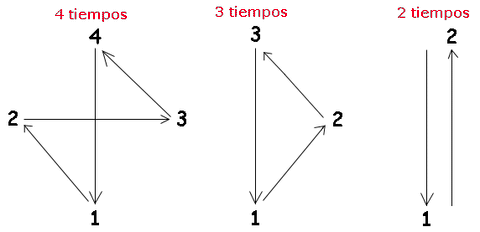
The top number indicates the number of beats that will fit in a single measure, as well as the largest note value that can be placed within that space.
The bottom number, for its part, indicates the beat unit, in other words, the note value that equals one beat.
These values change between simple and compound meters. In simple meters, the top number will be 2, 3, or 4; while the beat unit is expressed with the numbers 1, 2, 4, or 8, whether the meter is simple or compound.

These bottom numbers stand for the following note values:
- 1 = whole note
- 2 = half note
- 4 = quarter note
- 8 = eighth note
Let's explain it with an example: if our time signature is 3/4, it would be read as three quarter-note beats per measure. The largest note value would be the dotted half note, because it is the biggest figure that can be placed in each measure, since, as I have already mentioned, it is worth three beats.
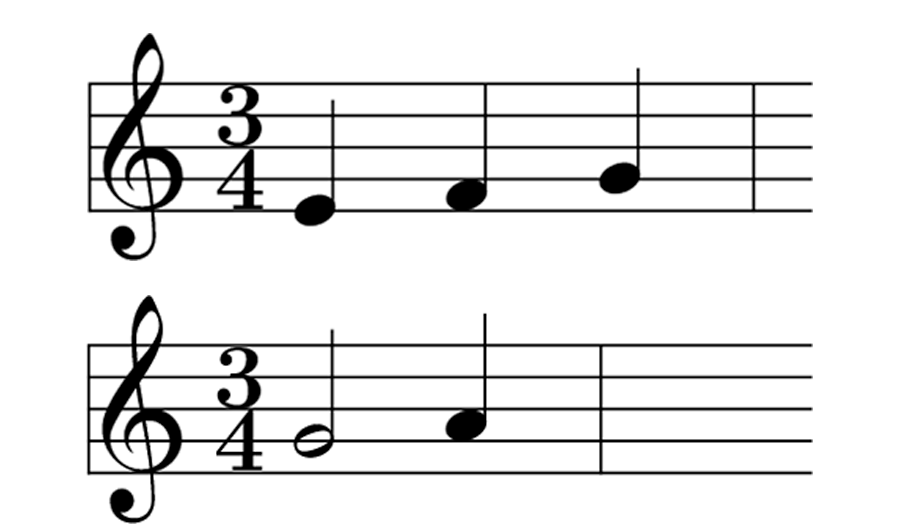
Likewise, the beat unit would be the quarter note, because it is the smallest figure that can be placed within that space.
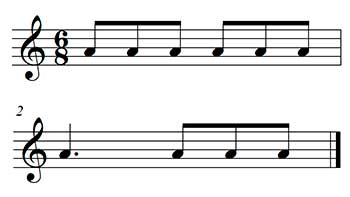
Now let's look at an example of a compound meter, where things work a little differently. A 6/8 time signature is not read as six eighth-note beats, because there is no such thing as a six-beat measure. Even when they are compound, measures always have two, three, or four beats.
To find out how many beats a 6/8 measure has, you divide the top number by 3. As a result, this measure is read as: two beats per measure. The number six means that six eighth notes fit in one measure; those six eighth notes are played or sung over two pulses.

In conclusion, the beat unit would be the eighth note, while the largest note value would be the dotted half note, a figure that is certainly worth three beats, but which, when broken down, equals the six eighth notes that must fit in the measure.
The time signature will help you know which are the largest and smallest note values you can place in different measures. That is where its importance lies; studying it is essential to understanding music.