Ornaments (Part I)

Within any piece of music, different notes and rhythms come into play to build a unique composition. What you may not know is that there are tiny notes called “ornaments,” whose job is to embellish the existing music through subtle, almost imperceptible effects.
As a rule, these little notes are written before a main note, and to be played they borrow part of its value. Some of them go by the names appoggiatura, mordent, and turn, among others. To learn more about them, be sure to read on.
Appoggiatura

As its name suggests, the appoggiatura acts as a “leaning note” that supports the main note. It is placed a step above or below the main note; for example, if the main note is A, the appoggiatura should be written on the line or space for G or B.
It is worth noting that this small note can be written with any rhythmic value you like (eighth note, sixteenth note, quarter note, or half note), printed in a smaller size. Its value is taken from the main note, so how quickly it must be played depends on the value of that note.

As a general rule, the appoggiatura lasts half the value of the main note, but when the main note is dotted, the appoggiatura takes the equivalent of two-thirds of the main note's value.
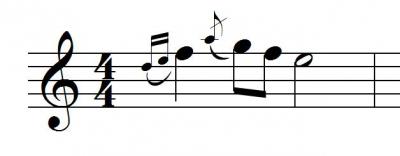
Appoggiaturas can be single or double. Single ones are written with just one note, while double ones use two notes. Let's take a closer look at the double appoggiatura:
For the double appoggiatura, you simply write two small notes, one a step above and the other a step below the main note. As with the single appoggiatura, the value of the double one is taken from the main note, but since there are two notes—usually eighth notes or sixteenth notes—they must be played quickly, as they have to fit within a single beat.
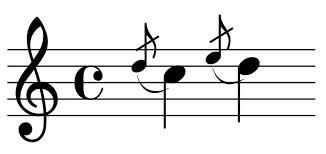
The acciaccatura is another type of appoggiatura, characterized by how quickly it must be played—almost instantly. It is written as a small eighth note a step above the main note and slurred to it; this eighth note is crossed out with a diagonal stroke through its stem.
Mordent
Like the acciaccatura, the mordent is played very quickly. The difference is that it is always written either with two sixteenth notes or with a small zigzag symbol. These notes start on the main note, move to the note immediately above, and then return to the main note. According to the experts, it should be played both quickly and crisply—almost imperceptibly.

Turn
As its name suggests, the turn is a group of three or four notes that circle around the main note, and they are written only with sixteenth notes or thirty-second notes.
Let's explain the three-note version with an example: if we have the note C, possible turns can be created by writing the notes G, A, B or B, C, D, before landing back on the main note—in this case, C.
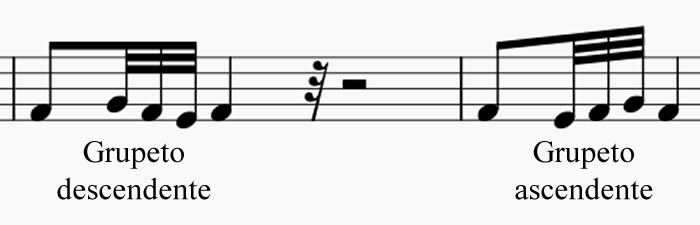
Four-note turns are indicated with an S-shaped symbol, which can be either upright or lying on its side. When the S lies on its side, it means the turn begins on the upper note; in the opposite case—that is, when the S is upright—the turn begins on the lower note.

These notes are written as follows:
- For an ascending turn: upper, main, lower, and main
- For a descending turn: lower, main, upper, and main

There are a great many ornaments, which you'll get to know in upcoming articles, so I invite you to keep an eye on my posts, as I'll be putting together more interesting content for you.