Ninth Chords
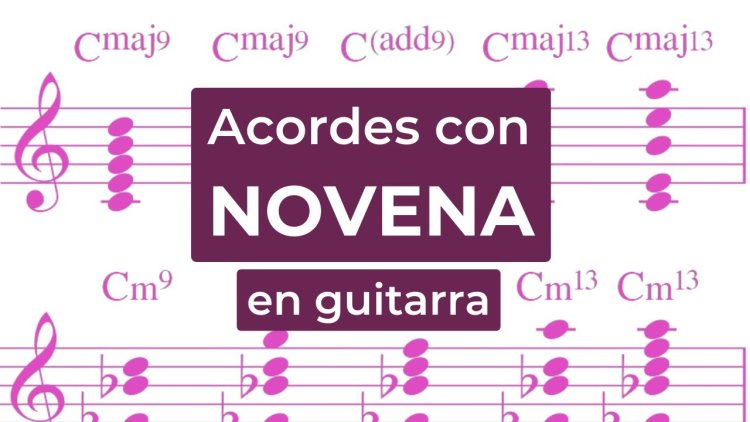
As we have seen in previous articles, there are triad chords, seventh or four-note chords, and also ninth chords. These are built by stacking another third on top of a seventh chord, and they get their name because there must be an interval of a ninth between the root and the top note.
It's worth remembering that, when you invert this last interval, you get the distance of a second. This means that if we have a solid command of the second, we can do the same with the ninth interval mentioned above, allowing us to build these chords easily.
It's important to note that ninth chords can be written on any degree of the scale except the seventh, since that would be the leading tone of any progression.
If you'd like to learn more about these chords, be sure to read this new article.
Types of Ninth Chords
A chord is formed by several stacked thirds; in the case of ninth chords, four intervals of this distance are stacked. Depending on their makeup, the following types can be built:
Major ninth chord: made up of a major third, then a minor third, then a major third, and finally a minor third.
Minor ninth chord: built from a minor third, a major third, another minor third, and finally a major third.
Major dominant ninth chord: composed of a dominant seventh chord plus a major ninth.
Minor dominant ninth chord: built from a dominant seventh chord plus a minor ninth.
How Should These Chords Resolve?
In a four-voice harmonic composition, it's important to keep the following points in mind for a correct resolution of this type of chord:
- The leading tone should move to the tonic.
- Both the seventh and the ninth should resolve downward by step.
It's worth noting that, in any melodic and harmonic composition, it's important to omit the fifth, while the ninth should sit above the leading tone when making a voice connection.
It's important to mention that both the seventh and the ninth should be prepared; if that isn't possible, they should approach and resolve by step.
Generally speaking, these chords are written in root position, without needing to invert them, so they will be easy to tell apart from the rest.
Why Are These Chords Important?
The more notes there are, the fuller the chords will sound, which is always what we're after when composing music. But we must remember that certain notes create tension, as is the case with the seventh and the ninth; these tensions must be resolved right away to give the piece of music a sense of continuity.
As mentioned earlier, in the case of dominant ninth chords, the tension notes (the seventh and the ninth) must be resolved by step. With the other chords these rules can change, and we'll explain that in upcoming posts.
Learning chords is always important when it comes to music composition, which is why the invitation is to keep practicing these topics so that one day you can become the composer you've always wanted to be.
1 Comments