Let's Talk About Minor Scales
Scales are another of the most important pillars of music. This succession of eight notes acts as a kind of reference within a given key, and scales are classified as either major or minor. We previously studied the former, but in this article we'll describe minor scales, so if you want to learn everything about them, keep reading.
How are minor scales built?
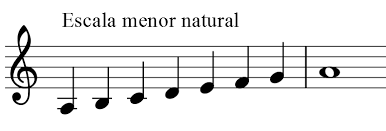
To build these scales, you need to find the relative minor of a major scale, which simply means lowering the tonic of the major scale by a minor third. Let's explain this with an example: the relative minor of C major is A minor. This scale has no accidentals in its key signature because it comes from the C major scale we just mentioned.
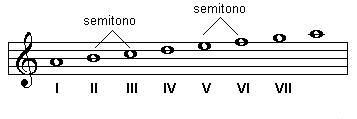
To recap what we've covered, major scales have two diatonic semitones, located between the third and fourth degrees, and between the seventh and eighth. Unlike major scales, minor scales have three diatonic semitones, located between the following degrees:
- Second and third.
- Fifth and sixth.
- Seventh and eighth.
Going back to the A minor example, when we write out the notes that make it up, we'll notice there are no accidentals. Right away, something will jump out at us: the whole tone between the leading tone and the tonic. To fix this important gap, we'll need to add an accidental to that degree. In this case it would be a G# so that the diatonic semitone exists and the leading tone regains its importance. However, the leading tone doesn't always have to be raised. Believe it or not, there are three types of minor scales, each with different rules:
Natural (Aeolian): it keeps all the accidentals found in its relative major, meaning no note needs to be altered. The A natural minor scale has no accidentals at all.
Harmonic: the seventh degree is raised, and it stays raised from the beginning to the end. The A harmonic minor scale has a G sharp on its seventh degree.

Melodic: the sixth and seventh degrees are raised on the way up in order to avoid the augmented second interval that forms between those two notes. On the way down, however, they revert to the natural minor form. In this sense, the A melodic minor scale will have F sharp and G sharp ascending, but on the way down naturals must be added so it descends as a natural minor.

Other characteristics of minor scales
The mediant and submediant must be lowered by a chromatic semitone. As a result, the third and sixth intervals that begin the scale must be minor.
It's worth noting that both the mediant and the submediant are very important within these scales, since they are the modal or characteristic notes of whatever key you're in.
When building any of these scales, it's important to keep the key signatures in mind, because they themselves will tell you how to proceed. For example, if you have a sharp, you must add a double sharp to raise the pitch. On the other hand, if you have a flat, you must add a natural to raise the note in that key
The different minor scales have different sounds that are easy to tell apart. It's worth mentioning that building them isn't an easy task at first. For that reason, constant practice is essential. You'll see that, over time and with the rest of the articles you'll be reading, you'll become an expert on the subject before you know it.