Let's Talk About Interpretation!
As we have mentioned many times before, music shouldn't just be played—it also needs to be interpreted and felt in order to achieve a truly polished performance. All too often, the musician is focused solely on singing or playing the notes at the right rhythm, overlooking elements such as accentuation, phrasing, dynamics, and character.
In this article we'll explore the different types of accents and the importance of phrasing in musical interpretation, so be sure not to miss it.
Phrasing
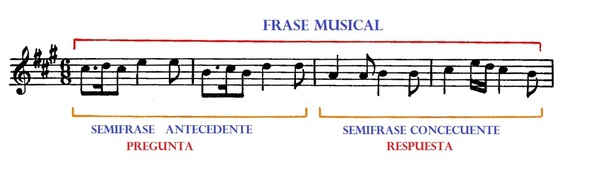
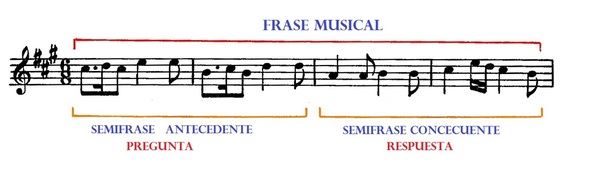
For better understanding and execution, musical works are divided into multiple phrases, each with a different intention that makes it unique. In this regard, dynamics play a fundamental role: in some pieces, markings such as forte and piano may be present, while in others the score is left blank. In those cases, the performer must rely on their own musical judgment to decide which markings are best suited to playing or singing the piece.
With that in mind, we can define phrasing as a musician's ability to give intention to musical phrases in order to convey to the audience what the composer set out to achieve with the work.
A lack of phrasing leads to monotony—which is exactly why it matters at every moment.
Accentuation

Within a phrase, certain notes call for greater emphasis because of their importance. This added effort is known as accentuation. There are several types of accent, which you'll learn about below:
Staccato dot: this small dot can be placed above or below the notes to indicate which ones should stand out at a given moment. Notes marked with this symbol should be played shorter. Generally, this marking appears most often in string instrument parts.
Accent mark: like the staccato dot above, it can be placed above or below the notes; the difference lies in how it is played, since notes carrying this marking should be played or sung with a stronger attack. This symbol tends to appear in a wider range of scores.
Slur and dot: although these are two opposing signs, they can be combined in certain scores to indicate that the notes should be performed within a single articulation, but separated and played gently—some composers refer to these as portato (slurred staccato) notes.
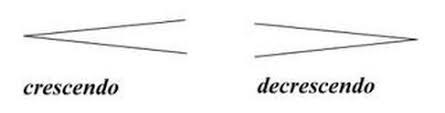
Another type of accent is marked with a sign resembling a small decrescendo, written above the note to indicate that it should be played more forcefully, while the note that follows should be softer.
On top of all this, there are several Italian terms and abbreviations used to indicate certain intensities.
- Forte Piano (fp): strong on the first note and soft on the next
- Piano Forte (pf): soft on the first note and strong on the next
- Legato (leg): smoothly connected; it can sometimes replace the slur symbol.
- Legatissimo: as smoothly connected as possible
- Leggiero (legg): light
- Marcato (marc): marked
- Pesante (pes): heavy
- Sforzando (sfz): with sudden force
- Sostenuto (sost): sustaining the sound
- Staccato (stacc): detached
- Tenuto (ten): holding the sound
- Ritardando (rit): gradually slowing down
These words or their abbreviations may appear in the score, and depending on the instrument you play, each will call for a different technique.