Irregular Note Groupings (Tuplets)
Now that we understand the concepts of the measure and the time signature, we can tell which note values fill a single beat and which ones span an entire measure. Within each beat, whether in simple or compound meter, we can introduce certain irregular groupings (tuplets) in order to pack as many notes as possible into a small space or, conversely, to place fewer notes in a beat or measure that would normally hold more.
Irregular note groupings, or tuplets, are perfectly acceptable in composition. They can be used either to fit fewer notes or more notes than would normally be allowed.
With that in mind, we are talking about the duplet, triplet, sextuplet, and many more that we will look at below. The duration of these groupings depends on the note value used to write them, although as a rule this cluster of notes is meant to fit within a single beat.
Duplet

This is a group of two notes, and it can be made up of any note value, as long as there are two of them. The most common is the duplet of eighth notes, an irregular grouping characteristic of compound meters, since the idea is to give two eighth notes prominence within a beat that would normally hold three. For that reason it is a grouping that uses fewer notes than usual.
Triplet

This is the division of a single note value into three equal parts within a beat that was conceived for two notes, in simple meter, which classifies it as an irregular grouping that uses more notes than usual. The most characteristic example is the triplet of eighth notes, a figure that lasts one beat.
Quadruplet
This is a group of four notes written in compound meter. It is the only grouping that can use either fewer or more notes, depending on the situation. Let's explain this with an example: in a compound meter, the quadruplet would use more notes than usual, since each beat normally holds three eighth notes, but it can also be a grouping with fewer notes than usual, since it can take the place of six sixteenth notes.
Quintuplet
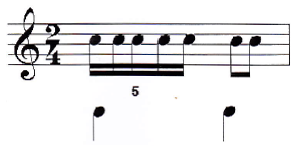
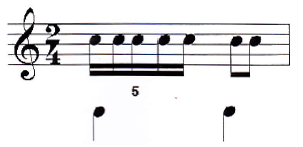
This is a grouping of five notes distributed within a space where only four notes would normally fit. It is an irregular grouping that uses more notes than usual, written in simple meter.
Sextuplet

This is the joining of six equal note values; in the case of eighth notes, it is as if you had two triplets joined together. These six notes are grouped to fill the place of four, which is why this grouping with more notes than usual fits within simple meter.
Septuplet

This is an irregular grouping that uses more notes than usual, consisting of seven notes placed in a spot meant for four. As a rule, this one is made up of sixteenth notes in simple meter.
Nonuplet
Another irregular grouping that packs nine notes into a space meant for eight. As a rule, nonuplets are made up of thirty-second notes.
Groupings of 10 to 15 notes are written with sixty-fourth notes.
Each of these figures is written with a bracket (or slur) and the corresponding number. It is worth noting that they are all performed differently depending on the meter and the tempo at which they are required.
Finally, remember that, in every one of these aspects, practice makes perfect, so the advice is always the same: study hard in order to master all of these groupings.