Interval Inversion
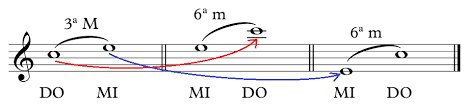
This is an exercise you can apply to both simple and compound intervals. The goal is to shrink distances that are too wide, while also letting you count the exact number of whole steps and half steps more accurately.
This technique comes with some very handy mnemonic rules that can make the job of recognizing intervals a whole lot easier. To learn more, be sure to read through this new article.
Inverting Simple Intervals
When you invert any simple interval, the results should work out like this:
- A second becomes a seventh, and a seventh becomes a second.
- A third turns into a sixth, and vice versa.
- A fourth becomes a fifth, and a fifth becomes a fourth.
- The unison, even though it isn't technically considered an interval, becomes an octave, and the octave becomes a unison.
To figure out the number of the new interval, the current interval number and its inversion always add up to nine. Let me explain with an example: to invert a seventh, you add two to seven so the total comes to nine. That tells you the inverted interval will be a second.
As for the quality of these intervals:
- diminished intervals become augmented.
- Major intervals become minor, and vice versa.
- Perfect intervals stay perfect.
Let's keep going with the previous example: if the seventh we're inverting is major, the second we end up with will be minor.
What About Compound Intervals?
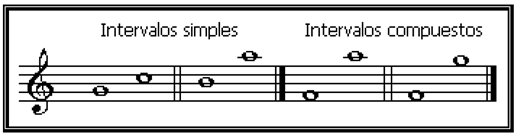
The quality and number always behave the same way for both simple and compound intervals. From the ninth onward, the distance between the notes is very large, so you'll need to turn it into a simple interval first.
To carry out that inversion, you need to bring one of the two pitches closer in, either the higher one or the lower one, so the two end up nearer to each other and are easier to count. That said, this process tends to be a bit long and calls for the following steps:
- Reduce it to a simple interval.
- Invert the reduced interval (the result of this inversion should be simple).
- Expand it back out to its original form.
- Keep in mind that for this inversion you add or subtract the number seven, depending on the case.
Let's walk through these steps with an example: say we have a minor tenth. To find out which simple interval it reduces to, we subtract 10 minus 7; that gives us 3, so the simple interval is a minor third.
Next, that minor third needs to be inverted using the rules for simple intervals, which gives us a major sixth as the result. After that, this sixth becomes a major thirteenth, since we add the number 7 once again.
Mnemonic Rules for Remembering Intervals
As we mentioned in the previous article, given the sheer amount of information you have to master, there are several mnemonic rules that will help you remember the different intervals. Here are a few of them:
- Major and perfect intervals always contain one half step.
- Minor intervals contain two diatonic half steps.
- A diminished interval always has one chromatic half step less than the corresponding minor or perfect interval.
- An augmented interval has one chromatic half step more than the corresponding major or perfect interval.
Naturally, these rules come with the following exceptions:
- Major seconds and major thirds have no half steps.
- Minor seconds and minor thirds have only one half step.
- The perfect octave has only two half steps.
Beyond memorizing these rules, it's important to practice exercises to recognize these intervals.