Guitar Chords Part 2

Now that you've gone through part one, let's move on to guitar chords part two so you can dig even deeper into understanding them and reach a level that few ever achieve.
It's no exaggeration to say that at least 90% of people who pick up the guitar never end up building, understanding, or even knowing how to use these chords.
The good news is that this time we'll explain how they're built so you can start playing them on your guitar, and in upcoming posts we'll also show you how to use them to achieve exceptional harmonic richness.
Musical intervals
In part one of our guitar chords series we gave you a guide to the guitar fretboard, which is enough to start locating the notes all the way up and down the neck.
Now, this time we're giving you the guide to intervals because in part one we mentioned them but never actually explained them.
A quick definition: an interval is the distance that exists between two or more musical notes. Some theorists also call them degrees, but for the sake of this explanation we'll simply call them intervals.
So, within a major scale there are twelve intervals, which are:
- The minor second sits one semitone from the tonic.
- The major second sits two semitones from the tonic.
- The minor third sits three semitones from the tonic.
- The major third sits four semitones from the tonic.
- The perfect fourth sits five semitones from the tonic.
- The diminished fifth sits six semitones from the tonic.
- The perfect fifth sits seven semitones from the tonic.
- The augmented fifth sits eight semitones from the tonic.
- The major sixth sits nine semitones from the tonic.
- The minor seventh sits ten semitones from the tonic.
- The major seventh sits eleven semitones from the tonic.
- The perfect octave sits twelve semitones from the tonic.
At the same time, in theory there's also the diminished ninth and the ninth interval, which are only written and read, but in actual performance they'd really be the diminished second and the major second.
In music we'll come across plenty of things that exist in theory, like E sharp or B sharp, but only show up in compositions that demand the highest level of notation and theory, even though in practice we know that E sharp is F and B sharp is C.
Intermediate-level guitar chords
All right, now we get to what everyone wants to do, and we're talking about extended chords.
5 dim chords
This chord is built by combining the tonic, major third, and diminished fifth. It's a chord widely used in complex ballad compositions like those of the now-disbanded Sin Bandera and Camila.
It's also super common in R&B compositions by Brian McKnight, Mariah Carey, Luther Vandross, and in other Gospel, Funk, Soul, and similar styles rooted in Black music.
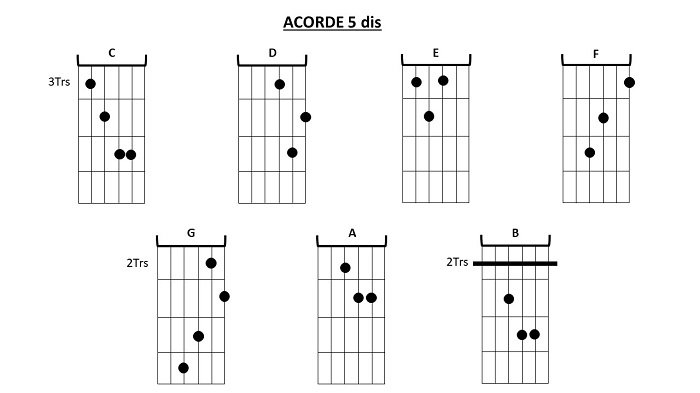
5 aug chords
To get this chord you need to combine the tonic, major third, and augmented fifth.
You can also turn this into a minor augmented-fifth chord simply by replacing the major third with the minor third.
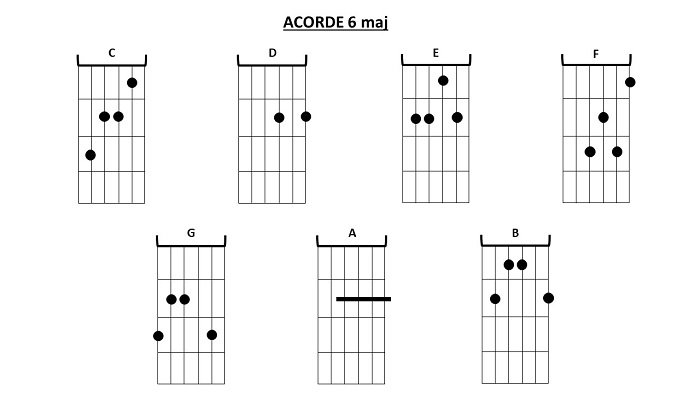
6 maj chords
This chord is seriously Gospel, and songs by artists like Michael Jackson, James Brown, Bruno Mars, Prince, Stevie Wonder, and many more use it because it adds a distinctive color to their compositions.
To get this chord you combine the tonic, major third, and major sixth intervals, since you drop the perfect fifth.
7 chords
I think every beginner starts out with these chords and knows how to play them on the guitar, but very few bother to learn how they're actually built.
Well, to get this chord you combine the tonic, major third, and minor seventh. In other words, you swap the perfect fifth for the seventh, though in some chord inversions you can keep all four degrees and there's no clash or dissonance that throws off the sound.
7 maj chords
Major seventh chords are widely used in all kinds of compositions because they offer a bright yet warm sound, rich in harmonic nuance, that adds beauty to all sorts of compositions and musical styles.
To get this chord you combine the tonic, major third, perfect fifth, and major seventh.
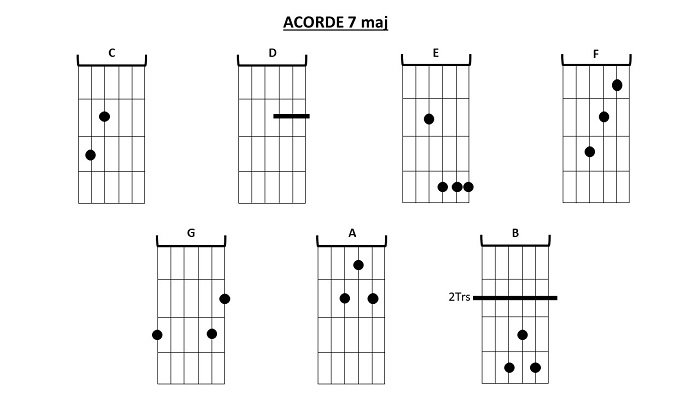
There you go, now you have more chords to practice and work toward an intermediate level in building them. Just remember that you need to practice them on your guitar so you also reach an intermediate level in playing.
We're leaving you a free PDF file to download that includes all of these chords for you.