Andantino Study by Ferdinando Carulli

You can't truly grow in your knowledge, technique, and command of classical guitar harmony without mastering Ferdinando Carulli's Andantino study.
This piece is at a beginner level and isn't regarded as a great composition, but the truth is that if you pay attention to what it offers in terms of technique and harmony, you'll come to appreciate everything Carulli's Andantino has to offer you.
Ferdinando Carulli
Ferdinando Carulli is one of those underrated guitarists and composers who were part of the Classical period.
Of course, with figures like Mozart, Beethoven, and Haydn, among others, many fine composers were left to live in their shadow.
That's why you rarely hear much about Ferdinando Carulli, but if you want to grow as a musician and guitarist, studying some of his guitar pieces is an absolute must.
Andantino on the Guitar
Andantino is a tempo marking that sits between Andante moderato and Moderato espressivo.
On the metronome, you can set yourself between 92 and 112 BPM to begin working on this composition.
That said, expressively this is a heartfelt piece: calm and relaxed, it seeks to express brief shifts in tempo with a cadence at the start of each movement.
For that reason, it's a good idea to listen to this piece performed by a skilled player so you can connect with it.
Carulli's Andantino
Overall, this classical guitar piece, which borders on the contemporary, consists of three clearly defined movements that you need to be able to tell apart in order to bring out the interpretive nuances it calls for.
Only then will you reach the heart of what Ferdinando Carulli wanted to convey to his audience.
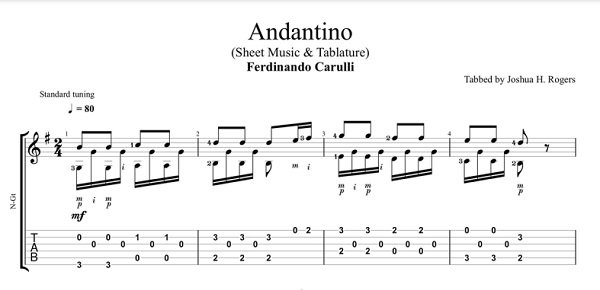
First Movement
Carulli's Andantino unfolds entirely within the first three frets of the guitar. As a result, the young guitarist gets to explore all the harmonic possibilities available within that short stretch of the instrument.
The key of this composition is built on the key signature of G major. The remaining chords that make it up are Am, Bm, and C.
When moving between the chords in this piece, it's very important for the student to begin with a crescendo. That way, the sound will give the impression of swelling in intensity when in fact it isn't, but that's exactly the idea.
Likewise, the technique calls for a conversation between the bass strings and the middle and high notes. For that reason, this classical guitar piece evokes the singing of a religious choir that blends together perfectly.
Second Movement
The second movement in Carulli's Andantino isn't marked out in the score, but it's there, and it's your ear that tells you so.
That's why the young guitarist needs to pay close attention so that this movement, which begins on the D major chord, can be brought out. In fact, that's precisely the intent: that the passage from D major should build in a crescendo, hinting at a quickening of the tempo.
With that in mind, remember that Andantino falls between 92 and 112 BPM. So you can play with the tempo within that range and it will still be Andantino.
Third Movement
For the third movement, the guitarist returns to D major and moves over a foundation of the chords C, Bm7, and G.
This is the close of the piece, and you'll be able to play it in a way that lets you master the expressive character of Carulli's Andantino.
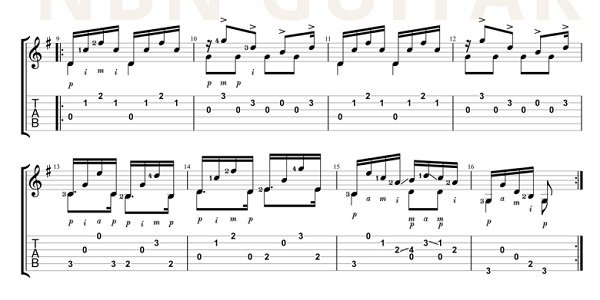
You can download this piece as a PDF along with the MP3 audio to gain a fuller understanding of what it's meant to achieve.