Analysis of "Roma" by Vicente Amigo
This time we're going to take an in-depth look at "Roma" by Vicente Amigo so you can get to know one of the simplest flamenco compositions out there, yet one with a stunning harmonic and tonal richness.
It's no surprise that this flamenco guitar piece has racked up millions of plays, with hundreds of YouTube videos devoted to covers and tutorials—some decent, others not so much.
Want an easy way to start playing bulerías? This is the best composition to use as a reference for taking your first steps in the bulería groove.
The tempo of "Roma" by Vicente Amigo
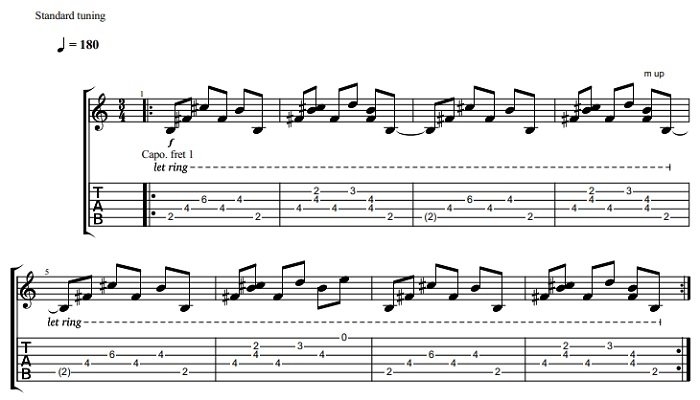
This piece is played in simple 3/4 time at a tempo of quarter note = 180.
That said, it's worth noting that bulerías can be written in 4/4 or 3/4 time, but they're subdivided into six or twelve beats. In this case, "Roma" by Vicente Amigo is played with a six-beat clapping pattern, with the accents falling on the first and fourth beats.
You can use the online metronome on the acompas.org website and set it up as shown in the image below.
Likewise, the tempo stays constant throughout this piece, as does the subdivision of the rhythmic figures, which always fall on eighth notes and remain in a never-ending loop.
For that reason, this is a composition that doesn't aim to be harmonically complex, nor does it demand great technical skill. Instead, it's focused more on expressing the feeling of flamenco bulería—and even more so, it seeks to evoke the feeling of the traveler cycling along the Camino de Santiago de Compostela, at the edge of Spain's deep-blue Atlantic, with breezes warm and soft as silk, and above all, with a view from cliffs steeped in nostalgia.
In this way, any musician who sets out to play "Roma" by Vicente Amigo needs to soak up this feeling in order to reach an interpretation worthy of the man from Guadalcanal, Seville.
The key of "Roma" by Vicente Amigo
As for the key this piece is played in, we're in C minor (Cm).
However, "Roma" by Vicente Amigo places the capo on the first fret of the guitar. The reason for this is to make the chords easier to play across the rest of the Cm harmonic progression.
That said, harmonically this piece has nothing complicated about it—there's nothing tricky to point out. Rather, it's built on what seasoned musicians call "the beauty of simplicity."
Every harmonic path leads to Rome
Just as all roads lead to Rome, in this composition the entire harmonic progression leads to "Roma" by Vicente Amigo.
- The intro is a loop of Cm(add2)
- The verse moves through the chords: A#7sus4 - A#7 - G# - Gm6 - Fm - G(add2) - G - C7.
- The chorus runs through the chords: Fm7(add2) - A# - D#maj7sus2 - Cm7 - Ddim - G
This way, simply by following the C minor harmonic progression, you'll be able to get at least a partial rendition of "Roma" by Vicente Amigo.
Once you have the chords down, it's important to practice the arpeggio, which is a constant throughout, and finally you move on to the rhythmic feel and flamenco spirit of this bulería.
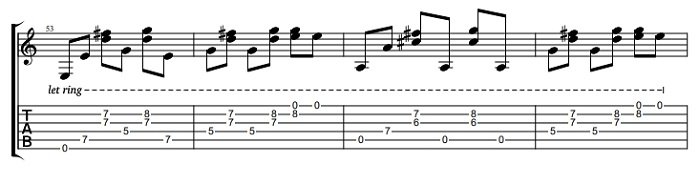
We're leaving you the free PDF download of this guitar piece in both standard notation and tablature.