A Study of Bulerías Falsetas
The flamenco guitar has earned worldwide recognition thanks to bulerías falsetas. This distinctive flamenco form is part of popular culture all around the globe.
It's no exaggeration to say that anyone who hears a bulería falseta will instantly recognize it as flamenco.
With that in mind, we're going to give you a brief explanation of what it is, its components, and an excellent method so you can start practicing bulería falsetas.
What Is the Bulería?
The bulería is a flamenco form, a rhythm, a tempo—a musical composition with a sound, chords, and a characteristic way of playing that sets it apart from the rest of the flamenco repertoire.
The Makeup of the Bulería
As far as tempo goes, bulerías falsetas are played in 3/4, 6/8, and 12/8 time, although the way the strong, semi-strong, and weak beats are accented is not the same as in academic chamber music.
When it comes to the chords, or the harmony of bulerías falsetas, they are commonly described as:
- Por medio: built on the harmonic foundation of Dm, though it always starts on the dominant chord with a flat second—that is, A(b2)—and that's how the por medio bulería is always played.
- Por arriba: in this harmonic approach to playing bulerías falsetas, the guitarist again works over the harmonic foundation of a minor chord and starts on the dominant with a flat second, but this time the chord sits higher up. So if you're working in Am, you start on E(b2).
Key Techniques in Bulerías Falsetas
To get a solid interpretation of bulerías, you need to learn at least three essential techniques:
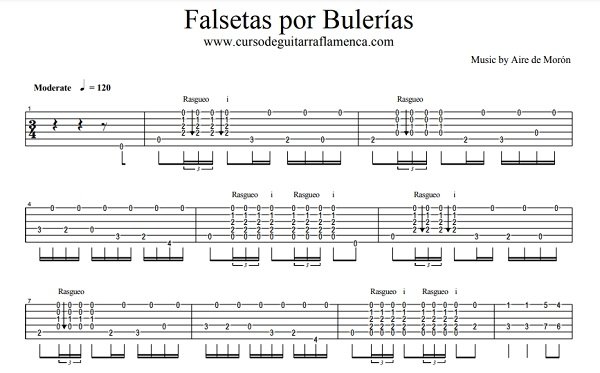
- Three-finger rasgueo: this is done with the ring, middle, and index fingers, letting them fall across the strings in a downward motion. If you're familiar with electric bass technique, it follows the same principle as the triplet in slap bass.
- Alza púa: a thumb technique in which you strike the strings using the thumb alone.
- Picado: a traditional single-note picking technique, but characterized by a strong, clipped sound. It's called picado because the note is “picked” so that it's cut short and sounds percussive.
The PEMI Method: Bulerías Falsetas
The PEMI Method for Bulerías Falsetas was written by Antonio Dovao and consists of eight bulerías falsetas.
The goal of the study is to help the new flamenco guitarist get comfortable with the form and style, taking their first steps into this musical idiom that's so characteristic of flamenco.
From the very first lesson, the new guitarist will begin playing bulerías por medio using the three-finger rasgueo over an Am base.
In the second falseta, you'll get to try out using the thumb together with the index finger to produce a thoroughly flamenco sound and technique. For this reason, we recommend a strong but clean attack to draw out the best sound from this movement.
Starting with lesson three, the new flamenco guitarist will get to explore the alza púa. This technique is essential, and you won't be able to progress in your development as a flamenco guitarist without mastering it.
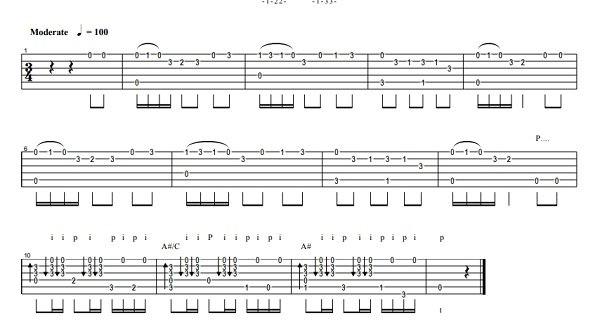
You can download the book as a PDF, which contains the sheet music with all the bulerías falsetas, so you can practice and begin your journey as a flamenco guitarist.