The Blue Danube Waltz: A Study Guide
The Blue Danube is a required study piece at music schools all over the world.
Above all, that's because it is a transitional piece. In other words, once you've learned it, you're ready to take the next step in your development as a pianist.
At the same time, it's one of the most famous pieces in the world and has essentially become part of our shared cultural heritage. That means just about everyone on the planet has heard it at least once.
So let's not wait any longer, because you're ready to dive into the study of The Blue Danube Waltz.
Johann Strauss
A composer born in Austria, his works bridge the twilight of the Classical era and the dawn of Romanticism.
Without a doubt, his most popular composition is The Blue Danube, and if anyone knows his name, it's mainly thanks to this piece.
Of course, Johann Strauss II has a far broader catalog of works, and these have greatly enriched the world of chamber music.
In fact, you'll find dozens of his works performed by the world's great symphony orchestras.
Some of the most important include:
- Vienna Bonbons.
- Fairy Tale.
- Tales from the Vienna Woods.
- A Thousand and One Nights.
- Cagliostro Waltz.
- Masquerade Ball.
- Figaro Polka.
Among many others, his compositions span waltzes, marches, polkas, operettas and more.
Even so, despite his extensive repertoire, The Blue Danube is the jewel in the crown, the signature work of his entire output and his most popular by far.
That's why we've chosen to study The Blue Danube, so you can take the next step in your growth as a pianist.
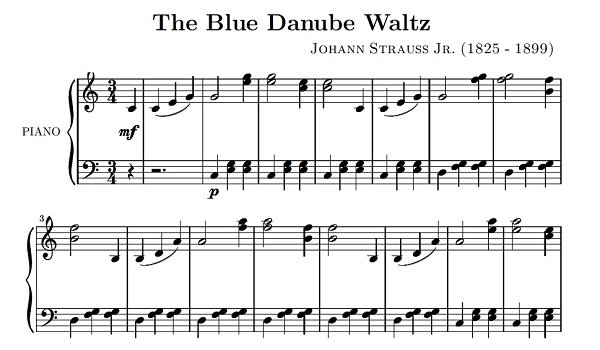
The Blue Danube: Sheet Music
This composition has survived for nearly two hundred years and remains, to this day, an invaluable part of our musical heritage.
In fact, if it could somehow be made tangible beyond a sheet of music, it would deserve a place atop the world as a monument to the beauty of life, nature, and humankind.
So it's no exaggeration to say that you need The Blue Danube in your piano repertoire.
Tempo
This composition is a waltz and, as such, it's played in 3/4 time at a waltz tempo that can range from 150 to 180 bpm.
The key to this piece is developing enough independence for your hands to do their work.
For that reason, we recommend starting your practice at a slow tempo and gradually building up the speed.
Likewise, the rhythmic subdivision stays consistently in quarter notes and half notes for roughly 99% of the piece. You'll only occasionally run into an eighth note, so you won't have any trouble reading the score while you play.
Harmony
Harmonically, this is also a fairly basic composition, and it's played in the key of C major, though you'll encounter variations on the melodic scale of that key.
We recommend analyzing each measure and chord as you go, then moving forward measure by measure as you master each one.
Remember that we've provided the sheet music in PDF format so you have a visual reference to follow.