Studying Brazilian Piano

The time has come to dig even deeper into your studies, and that's exactly why we're going to explore Brazilian piano.
This is one of the few musical styles that has won over audiences all around the world, and it has also inspired musicians of every kind to find new ways of seeing and hearing music at the piano.
For this reason, we believe that the new pianist at a beginner or intermediate level absolutely needs to learn and master at least the basics of Brazilian piano.
What is Brazilian piano?
The Brazilian piano refers to a group of musical styles with a sound rooted in Brazil's ethnic traditions, but with a strong jazz flavor and color.
When you listen to any Brazilian piano rhythm or pattern, you'll surely feel like you're hearing jazz, yet you'll also recognize that its foundation lies in the music of Brazil.
This is due to the close African-American connection between jazz, bossa nova, samba, choro, Baião, Forró, and others.
In this way, Brazilian piano is a blend of sounds from many cultures that are part of music the world over.
Musical genres of Brazilian piano
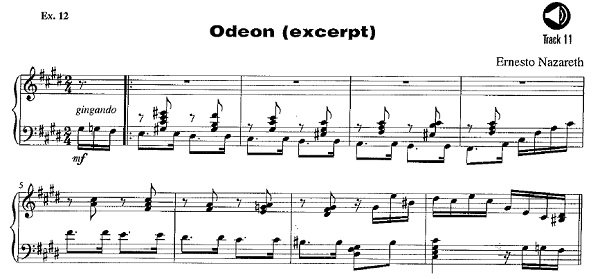
Brazilian piano is made up of a wide variety of rhythms or genres that are quite popular, such as Bossa Nova and Samba. Beyond these styles, we can also find others such as:
- Choro.
- Baião.
- Forró.
- Brazilian jazz.
We're not exaggerating when we say that the new pianist will grow by leaps and bounds by devoting a little time to Brazilian piano.
We're certain that a whole new way of seeing and interpreting music will open up before their eyes.
A Brazilian piano method
To get started with studying Brazilian piano, we think the best way to do it is with the method by Robert Willey and Alfredo Cardim.
This method consists of eight chapters that will guide the student through the theory, the technique, and the hands-on practice of Brazilian piano.
Brazilian culture
It's impossible to truly master a musical genre without first understanding the foundations of the culture that created it.
That's why the authors of the method believe that the student should know at least a little about the ethnic groups found across the five regions that make up Brazil.
They also mention some of the pioneers of Brazilian piano, such as Radamés Gnattali and Carolina Cardozo Menezes.
Rhythm patterns
With the accompanying audio, the student will get to know the 2/4 patterns on the Ganzá, as well as the so-called "Surdo" on the bass drum.
You'll also come across patterns in beat subdivisions played on the tamborim. After those, you'll be able to practice a few short patterns at the piano using major seventh, minor seventh, and ninth chords, along with combinations of them.
Choro
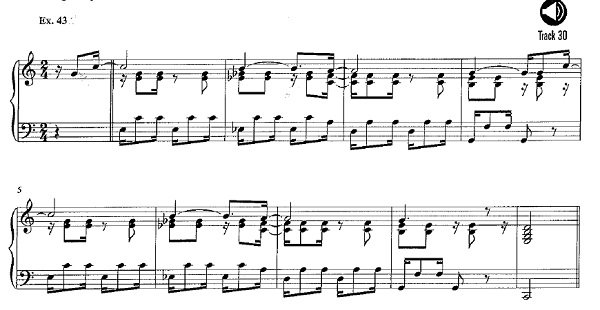
This is the first study you'll find in the Brazilian piano method, and it features offbeat patterns and syncopated notes that evoke jazz, but with an authentic Brazilian flavor.
Both this chapter and the ones that follow are packed with piano patterns, short compositions, chords, scales, the sheet music, and the audio, which all make an ideal complement for studying Brazilian piano.
Other genres the student will tackle include Samba and Bossa Nova, among others, while plenty of notable pianists get a well-deserved mention.
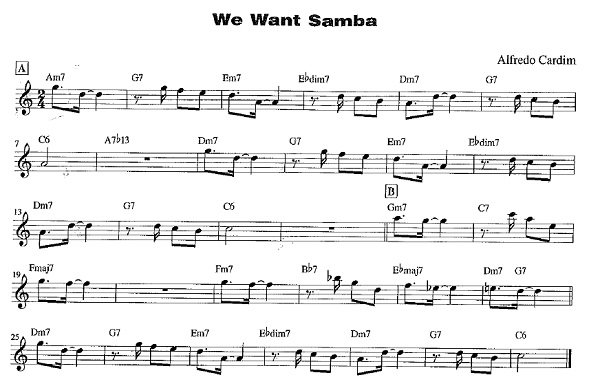
Remember that we always leave you the PDF of the book and the accompanying audio so that your study is complete.