Piano Sonata No. 14: Moonlight by Ludwig van Beethoven
No, you can't move forward or take another step in your piano training without first studying Ludwig van Beethoven's Piano Sonata No. 14.
In it there is form, there is feeling, there is harmony that reaches beyond Classicism; it is the prelude to Romanticism and the fulfillment of a legend.
Because of how important this composition is, we're going to leave you an analysis with a few tips and the sheet music along with an audio track.
Ludwig van Beethoven
Ever since that movie that made the Saint Bernard breed so popular, Beethoven has been part of the music world, right? Well, not really, but the dog in the movie sure was cute.
Ludwig van Beethoven is regarded as the greatest figure of Classicism and the beginning of Romanticism. This is because his works strike an intriguing balance that manages to bridge both worlds.
He is the prelude that opens one era and also the requiem that announces the end of another.
In him there is a joy intertwined with melancholy that is hard to explain but very easy to feel. That is why listeners in every era have been able to connect with him and come to know his work.
It was from this composer that the Piano Sonata No. 14 came, the subject of our study.
The Sonata
The sonata is a form of composition characteristic of Classicism that consists of four movements, and from Beethoven onward those four are:
- Allegro.
- Andante, Adagio, or Largo.
- Minuet or Scherzo.
- A new Allegro.
Beethoven, however, broke away from the standard sonata form, and with his Piano Sonata No. 14 he opened the door to a new school.
Piano Sonata No. 14
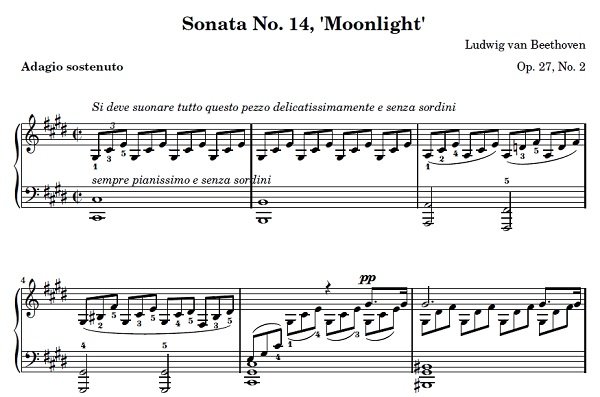
For the purposes of our study, we're going to look at the first movement, "Adagio," of Beethoven's Piano Sonata No. 14.
Movements
Now, although the most famous part is the "Adagio sostenuto" movement, the truth is that the Piano Sonata No. 14 consists of three movements:
- Adagio sostenuto.
- Allegretto.
- Presto agitato.
Key
Piano Sonata No. 14 is built on the key signature of C# minor, on which Beethoven works to achieve an opening unlike that of the sonatas of his time.
Expressively, it begins at the dynamic of pianissimo, and at certain moments a mezzo-forte comes in that gives it a thoroughly Romantic shading.
So we have that Beethoven's Piano Sonata No. 14 moves over the harmonic function of C# minor, and the chords that follow are:
- C#m
- C#m/B
- A
- G#m/B
- F#m
- C#m
- G#7
This would be the chord progression, but since it's a composition for piano, the right hand will often play inversions of the chords. The right hand can also stay on one chord while the left hand plays a different bass note.
This is what the harmony and counterpoint that we love so much about the Adagio sostenuto, Op. 27, No. 2 is all about.
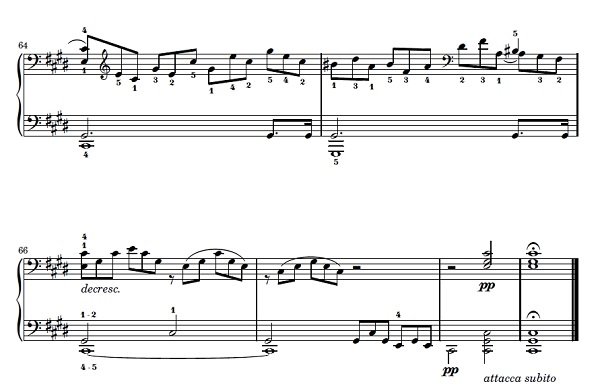
So, we're leaving you the free sheet music to download in PDF format, and you also have the MP3 audio of the composition with all three movements.