Piano Chord Inversions: Part 2

Now we continue with piano chord inversions so you can master all the inversions for the natural major chords: C - D - E - F - G - A and B.
As we have already mentioned, this is vital for the young pianist to develop a deeper harmonic understanding as well as greater technical skill on the instrument.
So don't miss what we have in store for you about piano chords.
Scale Degrees
By scale degrees, we mean the name given to each degree within a particular scale.
For example, in a natural C major scale we have the following notes:
C - D - E - F - G - A - B
Using this scale as a reference, we can see that in theory, the first degree, which is C, is called the tonic. The second degree, meanwhile, is called the second or the major second, depending on which book you consult.
In this way, all the scale degrees in a scale take on the following names:
- Tonic.
- Diminished second.
- Second.
- Minor third.
- Major third.
- Perfect fourth.
- Perfect fifth.
- Sixth.
- Minor seventh.
- Major seventh.
- Perfect octave.
When it comes to building chords on the piano and on other instruments, each degree gives its name to a part of the chord.
On that note, let's take the major and minor triad as our reference:
- Root (tonic): this is what gives the chord its name.
- Third: this determines whether the chord is major or minor.
- Perfect fifth: this adds harmonic stability to the chord.
So, if we see the chord written as "C," that is C major, but if we see it written as "Cm," then it's C minor, which means the third is in its minor form, a minor third above the root.
Piano Chord Inversions: Part 2
In Part 1 we looked at the inversions of the C major chord. So now let's move on to the rest of the major piano chords.
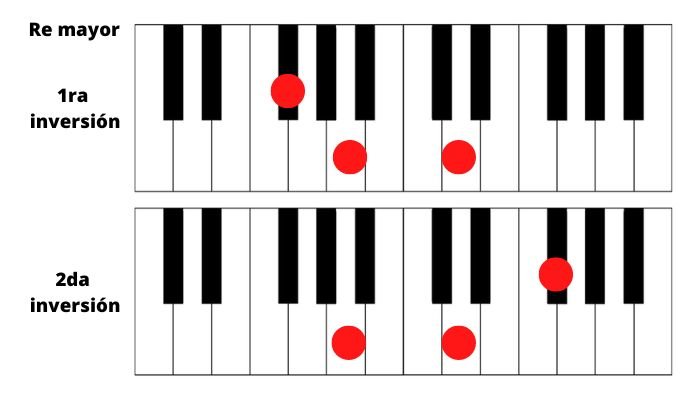
Piano Chord Inversions: D
The triad of the "D" chord is built from the following notes: D - F# - A. Therefore, its inversions on the piano are:
- First inversion: F# - A - D
- Second inversion: A - D - F#
E Chord
For this chord, the triad that forms it is E - G# - B. So the inversions of E major would be the following:
- First inversion: G# - B - E
- Second inversion: B - E - G#
F Chord
To form the F major chord, we have the three notes that make it up: F - A - Bb. So the piano chord inversions for this key are:
- First inversion: A - Bb - F
- Second inversion: Bb - F - A
G Chord
The G major chord is formed by combining the notes G - B - D, and with that as our reference, its two inversions would be as follows:
- First inversion: B - D - G
- Second inversion: D - G - B
A Chord
To build the A major chord, we need to combine the notes A - C# - E, and from there we can conclude that its inversions are:
- First inversion: C# - E - A
- Second inversion: E - A - C#
B Chord
Finally, the B major triad is made up of B - D# - F#, and its inversions are as follows:
- First inversion: D# - F# - B
- Second inversion: F# - B - D#
Now that you have the piano chord inversions, it's time to start practicing all of these shapes with both hands so you can train your ear to their sound and your hands to the positions.
Remember that you can download the file in PDF format and keep it on your computer.