Minor Chord Inversions on Piano: Part 3

The minor chords on piano are among the most widely used in every kind of composition. In particular, the great piano composers in chamber music leaned heavily toward minor keys.
That's why it's so important for new piano students to learn how to invert minor chords on piano.
Reasons to learn minor chord inversions on piano
We can list at least four reasons that stand out as the most important for understanding why learning minor chord inversions on piano matters.
- Nearly 80% of contemporary compositions are in minor keys.
- The most important piano pieces in chamber music are in minor keys.
- These minor chord inversions make it easier to move around the keys.
- Inversions add a great deal of harmonic richness to the voicing of the notes on the piano.
The minor triad on piano
In other posts we've already covered scale degrees and how they define a chord's name and quality.
We've also explained the modal degrees behind harmonic functions and how they determine the harmonic relationship between the chords within a given scale.
With that in mind, we're going to explain how the minor triad on piano is built, but remember that you can also check out our guide to inverting major chords on piano.
Now, every natural chord is made up of the combination of these degrees: the root, the third and the fifth. The root gives the chord its name, the third tells you whether it's major or minor, and the perfect fifth gives the sound its stability.
So we have that minor chords on piano must contain the root, a minor third (since that's what makes the chord minor) and a perfect fifth.
- Minor chord: root + minor third + perfect fifth.
Minor chords on piano
Starting from an understanding of the degrees that make up minor chords on piano, we can build the seven basic minor chords, which are the following:
The Cm chord
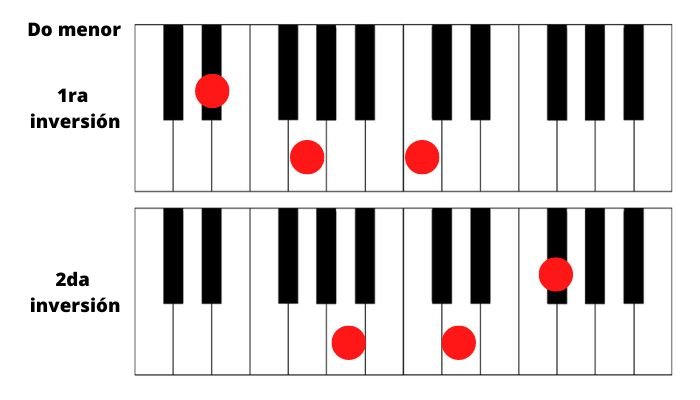
The C minor chord is made up of the triad C - Eb - G. Its inversions are therefore as follows:
- First inversion: Eb - G - C.
- Second inversion: G - C - Eb.
The Dm chord
Taking the minor triad on piano for Dm as our basis, we get the basic triad D - F - A. The inversions then go like this:
- First inversion: F - A - D.
- Second inversion: A - D - F
The Em chord
The root-position Em chord is made up of the following triad E - G - B. The two inversions of Em among the minor piano chords are therefore:
- First inversion: G - B - E.
- Second inversion: B - E - G.
The Fm chord
This is one of the minor chords on piano that students have found the trickiest. That's why it's so important to know its foundation, which is as follows: F - Ab - C; after that, you should practice the following inversions thoroughly:
- First inversion: Ab - C - F.
- Second inversion: C - F - Ab.
The Gm chord
Just like Fm, the G minor chord is another one of the hardest for piano students to remember, and it's built from the following triad: G - Bb - D. Its two inversions are:
- First inversion: Bb - D - G.
- Second inversion: D - G - Bb.
The Am chord
This is one of the most frequently used minor chords on piano, as are its inversions, which stem from the triad A - C - E. Its two inversions are as follows:
- First inversion: C - E - A.
- Second inversion: E - A - C.
The Bm chord
Finally we've reached the B minor chord, which is made up of the triad B - D - F#. Its inversions are as follows:
- First inversion: D - F# - B.
- Second inversion: F# - D - B.
Minor chords on piano should be practiced daily by new students, since they'll come across them throughout their basic training. So don't miss the chance to strengthen your knowledge of the inversions as well.
Remember that we've made the PDF file with all the minor chords available for free download.