Analysis of Mozart's Rondo alla Turca

Rondo alla Turca is one of the most iconic classical piano pieces, and few works have shaped the training of aspiring pianists more profoundly.
Between its technical demands and its tempo and harmonic richness, this piece is without question required study for every up-and-coming pianist around the world.
That's why we're going to break down this piece, which absolutely belongs in your repertoire.
Mozart's Rondo alla Turca
You can't talk about the Classical period without mentioning the supreme virtuoso of piano, violin, and composition—none other than Wolfgang Amadeus Mozart. And in the same way, you can't mention Mozart without bringing up the Rondo alla Turca.
This piano piece is more than two hundred years old, and it remains one of the most important works in the world.
As for how it's catalogued, it's the Piano Sonata No. 11 in A major, K. 331: III. Allegretto. It's a long name, but one that captures everything this composition is.
The Structure of Mozart's Rondo alla Turca
There are three aspects that stand out in this piano piece, Mozart's Rondo alla Turca.
The first of these is the tempo: it's a fast piece that pushes the developing pianist to build technique. The second feature is the harmony, and finally, the movements.
The Tempo of Mozart's Rondo alla Turca
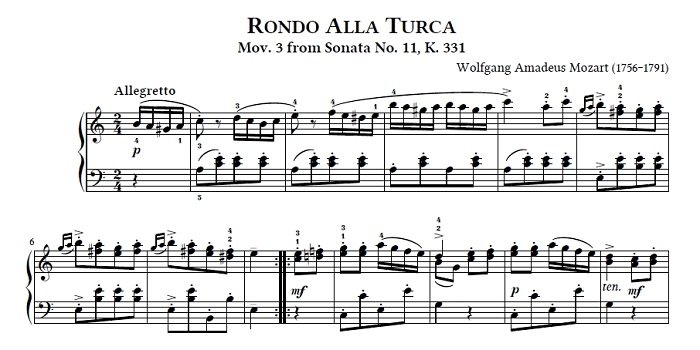
This piano piece is marked Allegretto, the tempo indication for a quarter note at 130 bpm.
Combine that tempo with the eighth-note subdivision in the left hand and sixteenth notes in the right hand, and you have a demanding piece. Best of all, it's a piece used to pass the second year of piano study.
Finally, something that adds even more difficulty is that it's in the simple meter of 2/4, which heightens the rhythmic complexity.
The Harmony of Mozart's Rondo alla Turca
Harmonically, this piece is in A major with brief passes through E, Bm, and D, but nothing that adds harmonic complexity, since the goal is to let the right-hand passages shine.
After that, there's a harmonic shift to C major and then to Am, but again, nothing that makes the composition harmonically complex. This is a Minuet presented as a slower section to ease the tension before returning to the first movement.
Finally, we have the third movement, the Rondo alla Turca itself, which at first seems to break from the rest of the piece—but that's exactly the point: a variation that gives the harmony of this piano piece its meaning.
Without a doubt, every piano student should pay special attention to this part of the piece. Above all because it's a movement characteristic of Mozart's school, and also because it has a harmonic richness well worth imitating.
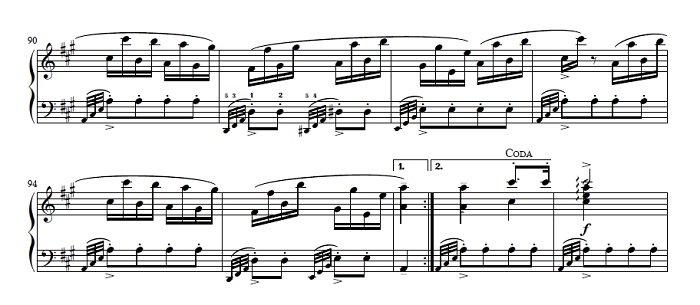
For all these reasons, we're leaving you the PDF of this composition so you can practice and start building your skills.
Mozart's Rondo alla Turca is an essential study piece you simply can't overlook.